
Ans. It is said that in order to determine the level of progress of any society, one should consider the place it gives to its women-whether it is running away from or running after (lusting) them.
The sign of an unhealthy society is the suppression of its women, to consider them inferior to men or a vehicle for pleasure and reproduction.
Women are an equal half of any society, yet the Western thinkers have often abhorred and avoided them by saying that they are an agreeable blunder of nature. Even a philosopher and thinker like Aristotle called them “an erroneous and incomplete development”.
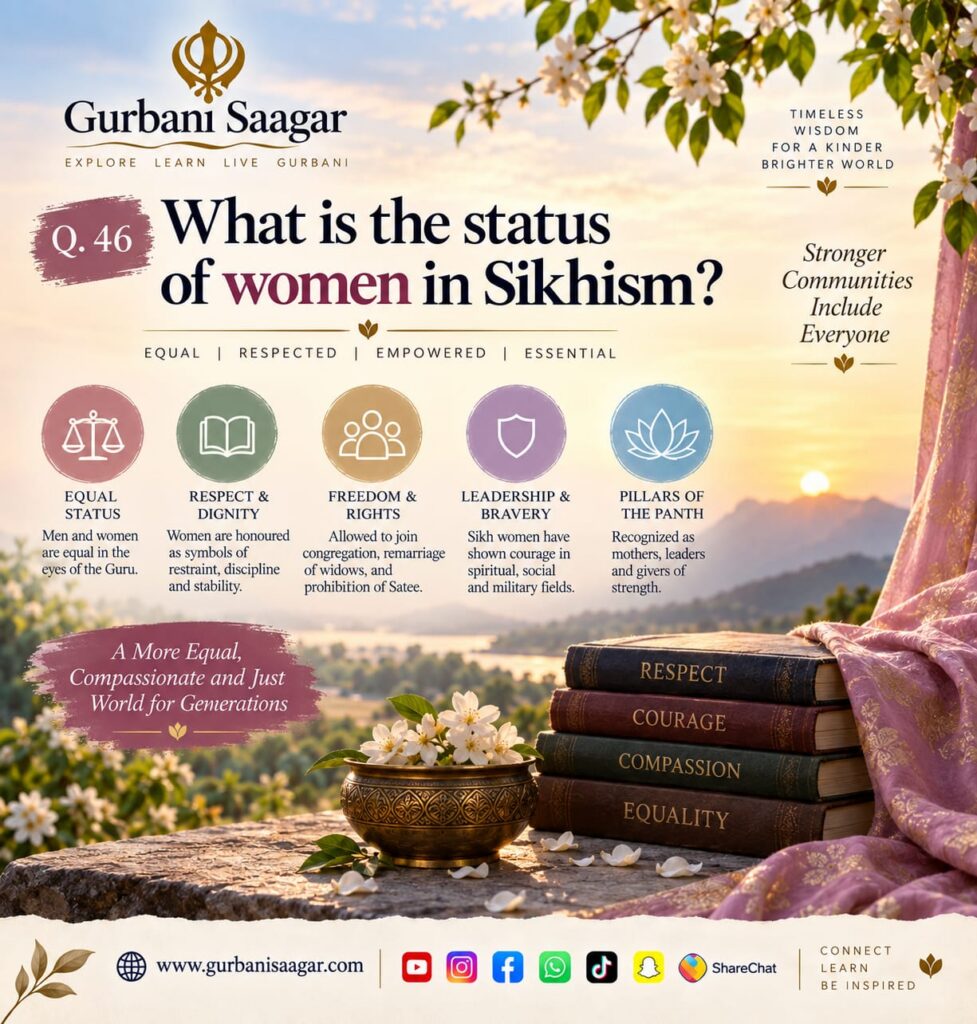
Contrary to these views, Guru Nanak declared women to be not only an ornament (to be worn with pride) but as the symbol of restraint, discipline and stability in the society:
ਭੰਡਿ ਹੋਵੈ ਬੰਧਾਨੁ॥
(SGGS, P. 473)
Guru Arjan Dev said, “Aurat yakina”, or a woman is man’s belief.
In an answer to a question Guru Har Gobind, the sixth Master said,
“A woman is embodiment of faith”
(Aurat eemaan).
Guru Nanak refuted those who propounded such unsavoury ideas as ‘a woman did not have a soul’, by declaring that it was a strange logic that the mother who gives birth to kings and sages is considered blemished while those born out of her are considered unblemished.
ਸੋ ਕਿਉ ਮੰਦਾ ਆਖੀਐ ਜਿਤੁ ਜੰਮਹਿ ਰਾਜਾਨ॥
(SGGS, P. 473)
A woman has many qualities. The Gurus honoured the woman by calling her “batteesulakhani”, or the one who possesses thirty-two (many) virtues.
A woman was traditionally supposed to stay hidden from men other than the members of her family, by keeping herself fully covered. But Guru Amar Das, the third Master, directed that she should wear clean clothes and not hesitate to come to the congregation, unhesitatingly and without covering her face with a veil.
The Guru also gave permission for remarriage of a widow and condemned the practice of “Satee”, the (forcible) burning of a widow on the funeral pyre of her dead husband.
When Mata Jeeto Ji (the consort of Guru Gobind Singh) added sugar drops to the Amrit that was being prepared for the five beloved ones (panj piaare) on that epoch making Baisakhi day, Guru Gobind Singh remarked:”
It is fortunate that you have come and added sweetness to the water”.The declaring of Mata Sahib Kaur, by Guru Gobind Singh, as the ‘mother of the Khalsa’, was tantamount to giving the Amrit (Khalsa baptismal ceremony) to women was a women equal status in Sikhism. Giving the right of administering revolutionary step in the history of Sikhism.In battles, the Sikh women fought shoulder to shoulder with the Sikh men. The reciting of the sentence in our daily prayer (Ardaas), “jihna Singhaan, Singhniaan ne Dharam het sees ditte” (those Sikh men and women who gave their heads for the preservation of Dharma), indicates the declaration of equal bravery and mettle of women.
Mata Sundari, consort of the tenth Master, when in Delhi, gave able guidance to the Panth for many years after the death of the tenth Master. When Banda Singh Bahadur deviated towards self-aggrandizement, she admonished him immediately through a letter saying, “Banda was given the service of Panth, not the emperor-ship, which was given to the Khalsa by the true emperor (Guru Gobind Singh).
It is appropriate to narrate here an example of valour and deeds of bravery of Sikh women.
When the Niranjania mahant of Jandiala complained against Bhai Taroo Singh to Zakaria Khan, the governor of Lahore, he also said,
“Taroo Singh has a sister and a mother who keep the kitchen warm and ready, day and night, for fugitive Sikhs. These women are so firm and steadfast in their resolve that they carry out these chores for the love for their Guru. They are so committed to their faith that even the threat of death would not deter them from their work”.
William Franklin has written that there are innumerable examples where Sikh women took to arms and forced the enemy to retreat. Prince Bedaar Bakht ran away from the battlefield due to ferocious valour of Bibi Rajinder Kaur (Patiala). The Jhatka, (the Sikh way of slaughtering the animal with one blow), was maintained by Mai Raj Devi in Gujrat. Mata Kishan Kaur and other Sikh women withstood the baton blows of the British police.L. Griffin has written that Sikh women are in no way behind Sikh men in the management and strategic planning issues. Some other examples are those of the wives of S. Charat Singh, Rani Sada Kaur, daughter of Bhai Tara Singh Gheba, Mai Phatto, daughter of Baba Ala Singh. A British author has written that if there was a single man in Punjab, it was Rani Jindaan (wife of Maharaja Ranjit Singh).