
Miri-Piri in Sikhism: Meaning, History and Teachings of the Sikh Gurus
INTRODUCTION
On the miri-piri concept in Sikhism a lot of literature has appeared, both in English and Punjabi. The Department of Guru Granth Sahib Studies, Punjabi University Patiala, devoted a whole issue of its journal in order to emphasise that this concept is fundamental to Sikhism. Since then, however, articles have appeared in some papers and journals that seek to confuse the issue. We, therefore, feel that a reiteration of the basic character of this concept of Sikhism will not be out of place. Before that, however, it seems necessary to briefly recount some other fundamental beliefs that underlie this doctrine:

(a) Concept of God in Sikhism: In every spiritual systemthe concept of God or the Spiritual Reality determines its world-view and its structure. In the hymns of the Japu ji, Guru Nanak calls Him the Creator Person, Self-existent, Eternally True and Guru. As Guru, He is both Enlightener and Guide. Further, He is called the Master, the Emperor who is benevolent and directs the world with His Will. He is not only the Creator Person, but is also immanent in the world and is the Fount of all values and virtues. This is how Guru Nanak describes Him.
(b) Spiritual Experience: The spiritual experience of theGuru further highlights that ‘He is All Love, and the rest He is ineffable’. The important aspect of this spiritual experience is that the Basic Reality, apart from being the Master of the creation, is guiding it with love. It is this spiritual experience of the Guru, which determines the Sikh world-view: that the world is real, and not an illusion or mithya. The bani says, “True is He; True is His Creation”. “True are Thy continents, and true Thy universes. True are Thy worlds and the forms created by Thee”. A consequential implication of a Loving God is that He expresses His love and all virtues in this world. This further fortifies the inference about the reality and meaningfulness of the universe. It also implies that the universe is not a purposeless mass of confusion, but is directed with a Will which is Altruistic. Also, the Fundamental Reality is deeply interested in guiding the world in all its spheres. As Emperor and Master of the world, He guides both the piri and the miri aspects of the universe. In fact, as its Benevolent Guide, He hardly makes a division between these two aspects, which are just man-made distinctions or splittings. It gives spiritual sanction to moral life of man, because the Basic Reality is the Fount of all virtues and values.
(c) Goal of Life: It is in this background of his descriptionof the Basic Reality and his Spiritual Experience, that Guru Nanak lays down the goal of man in the very beginning of the Guru Granth. He categorically rejects the ascetic path of withdrawal, remaining silent, one-point meditation or the like, but lays down that the path for the spiritual man is to move and work according to His Will. This is the emphatic goal in Sikhism. As compared to the earlier Indian systems it completely changes the very basis and direction of pursuit of religion. The failure of many scholars to grasp the radical departures Guru Nanak makes, is just due to the lazy notion that Guru Nanak was just a quietist Sant, or a part of the Bhakti movement. Keeping into view the spiritual experience of the Guru the changes he made were both natural and essential. For, where God, the Miri-Piri Master, is deeply interested in the world, and is guiding all spheres of life with His Altruistic Will, for the spiritual seeker to drop out or be interested in only a part of it, would be just incongruous, if not defiant, and self-contradictory. Thus in Guru Nanak’s system, for a Sikh to be a disinterested onlooker of the world and life, is just out of the question. In short, Guru Nanak lays down a fully life-affirming goal for the spiritual man without any aspect of it being taboo for him.
(d) Methodology: It is in the background of his spiritual experience and his concept of God, that Guru Nanak lays down the methodology of his system which, as we shall find, is so logically necessary. The first corollary of it is that withdrawal, monasticism and asceticism are rejected, and instead, the householder’s life is accepted. He condemns the yogis for “being idlers, and not being ashamed of begging alms at the very door of the householder whose life they spurn.” He declares that “liberation is possible even while playing and laughing” and that “the God centered lives truthfully, while a householder.” Every earlier Indian system accepts monasticism, asceticism, or sanyasa. In fact, asceticism is considered to be the Indian contribution to the world culture. Yet, straightaway Guru Nanak rejects all such worldviews, as directly or indirectly give credence to these institutions. It is important to grasp that there is nothing like half life-affirmation or half life- negation. Life is one composite whole. It has no non-essential compartments, that can be ignored or rejected. God is the Gracious Master of the entire universe and life, and for that matter, faith in Him leaves the seeker no choice to select some aspects and leave others. This is the fundamental spiritual fact which has to be grasped, so as to understand the revolutionary changes in goals, direction, ethics and methodology Guru Nanak makes. Thus the first corollary of his system is to accept every aspect of life and share its responsibilities.
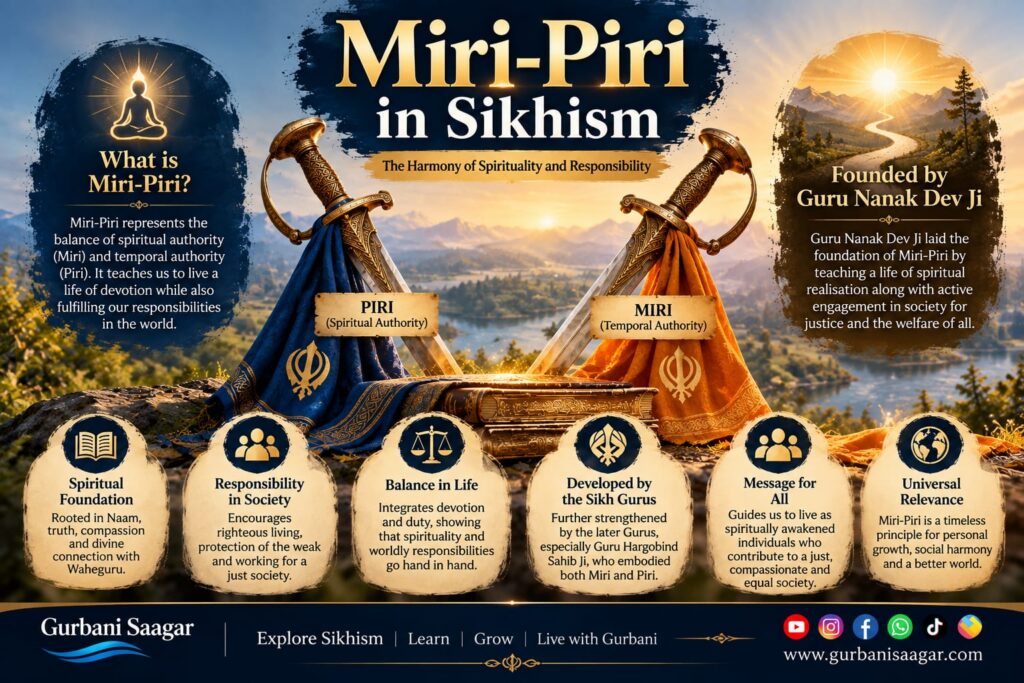
The corollary of rejecting monasticism is that the seeker has to express his sense of spirituality in virtuous activity and deeds. The stress is that in ultimate analysis all spirituality has to be lived in the form of human conduct and work. The bani says: “Man’s assessment in His Court is done on the basis of his deeds.” “It is by one’s deeds that we get nearer to or away from God.” “Everything is lower than truth; higher still is truthful living.” “Gurmukh always lives truthfully.””
This is the second fundamental of Guru Nanak’s methodology. He calls life a game of love, saying “If you want to play the game of Love, enter my lane with your head on your palm, and, once on this path, then waver not”. This principle he has unambiguously and repeatedly emphasised in his hymns in the Japu ji and elsewhere. For, a follower of God’s Will cannot remain a bystander in life. He has to work according to his capacity. Thus, Guru Nanak’s system means not only a whole-life spiritual venture, but also a life of continuous love and altruistic activity. Further, the responsibilities of the spiritual man, prescribed by Guru Nanak, logically follow from this. He stresses the need for productive work, which involves sustenance of man and life. He clearly deprecates the idleness of yogis and ascetics, and recommends a life devoted to virtuous deeds.
Here it would be relevant to state that while bhagats like Namdev and Ravidas clearly suggest withdrawal, the Guru says: “The person incapable of earning his living, gets his ears split (turns a Nath Yogi) and becomes a mendicant. He calls himself a Guru or a Saint. Do not look up to him, nor touch his feet. He alone knows the way who earns his living and shares his earnings with others. In this regard Machwe writes: The conflict between a rightful performance of duty and all-absorbing love of God, has existed at all times and in all countries. But it seems that the saints of this period were inclined in the latter rather than in the former direction, and exhibited an all-absorbing character of God realisation. God indeed is an all devourer, and it seems from examples of these saints that He devours also the performance of one’s own natural duties.”
Nihar Ranjan Ray writes: “They had no other social purpose in view than to make better individuals from out of the groups that assembled round them. Their aim seems to have been the individual, not the society in any significant sense”. “These leaders seem to have been individuals working out their own problems and towards achieving their personal religious and spiritual aims and aspirations”.” The responsibility about sharing is equally important, Guru Nanak and the other Gurus recommend sharing of the Lord’s wealth and bounties, and deprecate grabbing and accumulation of wealth. The bani says: “God’s bounty belongs to all, but men grab it for themselves”. “Man gathers riches by making others miserable”.
Another responsibility, which is so natural and logical in Guru Nanak’s system, but which is new in the Indian context, is the spiritual man’s responsibility to resist and confront injustice and oppression. Here again, what Guru Nanak did was, in the Indian religious tradition, absolutely radical. In India all earlier religions and systems accepted the value of sanyasa, withdrawal, monasticism, celibacy and ahimsa. The Kshatriya alone was asked to fight but that only as a part of his caste duties. Any departure from the duties of one’s caste, was frowned upon in the Bhagwat Gita and other Hindu scriptures. But Guru Nanak, being very conscious of this background and having laid for the seeker the responsibility of resisting injustice and oppression, it is he who took a number of tangible steps to clarify the issue. First, unlike most saints and bhagats, he criticised in detail all the faults in the social, administrative, religious and political life of his times. He deprecated the hypocrisy, greed and evil ways of Pundits and Mullahs, the social discriminations and practices of pollution following the caste prohibitions, the corruption, bribery and blood sucking practised by public functionaries in the Administration, the luxurious life lived by the rulers, their oppression of the people and their failure to give security of life to their subjects, and the tyranny, cruelty and butchery indulged in by the invaders. Few saints, prophets or mystics have so clearly detailed the faults and dark spots in the socio-political life of the times, as did Guru Nanak. His was not an idle rhetoric. The second step he took in this direction was his hymn in which he complains to God for allowing the weak to be trampled upon by the strong. It is a hymn of crucial importance and implications. It is in fact a corollary of themiri-piri system which he followed. The first implication of this hymn is that in the Order of God, oppression of the weak and the downtrodden is an aberration. The second inference is that this being so, it is primarily the duty of the spiritual man, as an instrument of God’s Will and Order, to undo and resist oppression and injustice.
The third inference is that, as such, it is the duty of his disciples and the Sikh society he was creating, to face and tackle all problems of injustice and oppression. And fourth, that, in this context, a society with necessary wherewithal had to be created, which should be in a position to undo injustice. In order to shoulder this spiritual responsibility and accomplish the task, again it is Guru Nanak who initiated three steps. First, he started the organisation of a Sikh society or sangats which could carry on his mission and discharge its responsibilities. And, it was at the time of Guru Nanak that such organisations were created at different places he visited. The second step which he took was to discard the institution of ahimsa. This was an essential step for any society that had to confront themight of the tyrants, the oppressors and the unjust. This is a particularly significant step, because all the religious Indians including the bhagats were devoted votaries of ahimsa as a creed. Guru Nanak stated that people did not understand what was sin. and were confused over issues like vegetarianism and the use of force. Guru Nanak clearly saw that no society that had to undo injustice and oppression, could remain fettered with impediments like ahimsa. And the third important step which Guru Nanak took was that, since the society he was creating was still in its infancy. and could not be motivated overnight to face the gigantic problems of injustice and oppression in the conditions then prevailing in India, and since it was to be a great long-drawn task to train and condition people to accept the responsibility of undoing injustice, he started the institution of appointing a successor, so that the succeeding Gurus could accomplish the targets and tasks of his mission. From the above it is evident that the miri-piri thesis is not only a part of the spiritual experience of Guru Nanak, but it is also he who in his own lifetime took all the necessary and basic steps, theoretical as well as organisational, so as to implement and continue his spiritual mission. This explains the uncommon system of appointing a successor which no other bhagat or prophet adopted, but which Guru Nanak considered essential for the continuance and completion of his mission.
GROWTH OF MIRI-PIRI TRADITION
Now we have to look at the development of the miri-piri tradition, initiated by Guru Nanak, during the period of the subsequent Gurus. We have explained that whole-life or a miri-piri system is fundamental to Guru Nanak’s spiritual perception and the mission he started. Guru Nanak had taken clear and firm steps to lay the foundations of the miri-piri structure. The measures he took in his life time and the system of succession he introduced, cannot be explained otherwise, than as a consequence of his whole-life system and his desire to develop it further through his successors. In fact, the introduction of the idea of succession, becomes ununderstandable, unless it is seen as a clear, conscious, and specific step toward building a miri-piri structure and society.
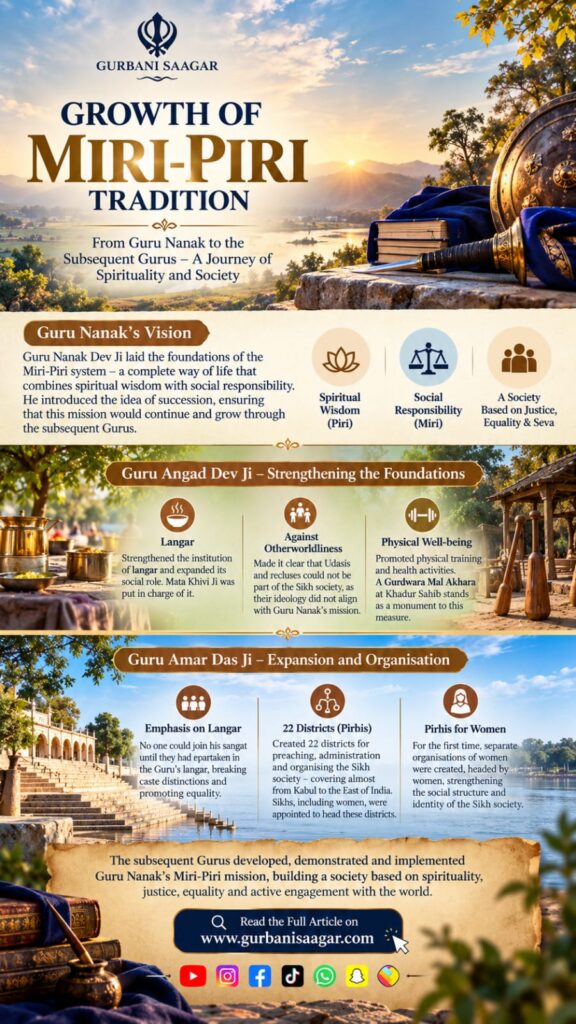
For, so far as the ideology was concerned, it had been laid down in Guru Nanak’s hymns in the Guru Granth completely, very succintly and emphatically. The subsequent Gurus made no addition to or alteration in the thesis of Guru Nanak. Their role can thus be understood primarily as development, demonstration and implementation of Guru Nanak’s mission in the socio-spiritual field. It is not at all meant that other aspects of his system were not carried out. But, because of the need of the subject under discussion, in the subsequent paragraphs we shall confine our narration of events to the development of the miri-piri aspect of Guru Nanak’s mission. For that reason our statements may sometimes look unavoidably selective.
It is on record that when Guru Nanak visited Guru Angad at Khadur Sahib, shortly after the latter’s appointment as Guru, he found him leading a somewhat secluded life. He, therefore, reminded him that he was to organise and lead a mission and that, as such, further extensive steps had to be taken. Guru Angad took three tangible measures which indicate that Sikhism was to develop as a socio-spiritual growth and society. He strengthened the institution of langar, which Guru Nanak had initiated. Its social role was expanded. The Guru’s wife (Mata Khivi) was put in charge of it. This institution, as a measure of attack against caste distinctions and of providing free food for the indigent, became quite well known in the area, and finds mention in the Guru Granth. Second, he made it clear that Udasis and recluses could not be welcome in the Sikh society, since their otherworldly ideology was incongruous with Guru Nanak’s system. Third, the Guru promoted the physical well-being of the members of the society through physical training and health activities. A gurdwara Mal Akhara at Khadur Sahib is a monument to this measure adopted by the Guru.
The Third Guru, Amar Das shifted the venue of his activities to Goindwal which was on the bank of the river Beas and a known place for crossing the river. Guru Amar Das took an unusual step to emphasise the institution of langar. No one, big or small, could join his sangat, until he had given evidence of his anti-caste and anti-pollution views by eating on a common platform of food from the Guru’s common kitchen, where no disticntion of high and low, Brahmin or non-Brahmin was made, and where food was cooked by any of the Sikhs irrespective of his or her caste. The significance of the measure is tremendous, considering the fact that in the Hindu temples, Nath monastries, or other religious places of Vaishnavas, food is cooked by Brahmins alone.” The republican and anti-caste character of this masure can also be guaged from the fact that, even in the twentieth century, a statue of a Brahmin unveiled by the Deputy Prime Minister of India, was considered to have been defiled, because of the touch of the then Deputy Prime Minister, who belonged to a low caste, and had later to be purified with waters from the Ganges. The hold of the caste structure is so pervasive, that even Mahatma Gandhi in this century felt that unfettered entry of untouchables into the Hindu temples was not possible because of the religious injunctions, which evidently he was not willing to disturb or violate, because of his faith in the existing Hindu structure. In fact, the best he suggested was that in some temples the untouchables could go during fixed hours only, and thereafter the temple could formally be purified by the prescribed method for undoing the pollution or defilement caused by the visit of low castes. The second major organisational step the Third Guru took was the creation of 22 districts for preaching Sikhism and administering and organising the Sikh society. The area covered was almost from Kabul to the East of India. The number of districts was the same as the number of political provinces in the country. These districts catered to the religious as well as secular needs of the Sikh society. Sikhs, including women, were appointed to head these districts. It is also reported that for the first time separate organisations called pirhis of women were also created, which were headed by women. Third, in order to establish separate identity of the Sikh society, to create a consciousness about their independent social standing, and to dissociate the Sikhs from the Hindu practices and places of pilgrimage he created a bauli at Goindwal as an alternate place for the biannual religious visits, gatherings, education and regeneration of the Sikhis. In short, by this time the Sikh society had reached a new stage of awareness not only of their ideological identity, but also of their distinctive role as a cohesive social group. They developed motivations to achieve the new goal set for them. The Ministry of the Fourth Guru lasted only for seven years. But he too made the momentous decision of founding Amritsar as the sacred centre of the new community and developing it as a new township which has since then played a crucial role in Sikh history. It has become the Vatican of the Sikhs, and, in fact, their throbbing heart. The history of the Guru period and the subsequent periods shows that enemies of the Sikhs have always believed that subduing Amritsar would mean the decline of Sikhs and their ethos.
The role of the Fifth Guru is extremely important as the leader of a miri-piri society. The earlier Gurus had created a formal and well-knit organisation socially and religiously cohesive and idelogically committed. Guru Arjun also accomplished the momentous work of compiling and authenticating the Sikh Scripture, thereby making the ideological break with the traditional form of Indian society complete. It is in his time that the Sikh society was taken by his contemporaries and historians to be a ‘state within a state’,” in which the Guru was formally taken by the Sikhs to be the real emperor or the sacha patshah of piri and miri. He was the first Guru to introduce the system of daswandh, namely, that every Sikh contributed one tenth of his earnings towards the cause of the Sikh society. In fact, nothing could be more regal than the introduction of this collection and reorganising the system of manjis and masands. They were not only supposed to make collections for the Centre, but also to cater to the spiritual and secular needs of the local Sikh society. In fact, the Fifth Guru openly and visibly created a socio-religious organisation, which, if seen in the background of the religious history of man, finds hardly a parallel. Neither Buddha nor Lord Mahavira, nor Moses, nor Christ created a comparable organisation of the size and structure developed by the Fifth Master. As we have said, the work of motivation and conditioning had continuously been done to give the Sikhs their cohesion and direction. It is at this stage, that the Fifth Master with his supreme vision took some other organisational steps. He finalised the Sikh Centre and the town of Amritsar. He created a similar town and temple with a large tank at Tarn Taran in the heart of the Majha area. The Guru constructed a number of tanks at other places, too, as public works, because in those days Punjab suffered from scarcity of rains, and famine conditions frequently prevailed. He dug a tank at Santokhsar by raising contributions from far and near. The Amritsar tank was widened and deepened. The Guru dug another tank called Gangsar and started the township at Kartarpur. A bauli was also constructed at Lahore. Similarly he dug a well which could feed six Persian wheels, the place being called Chheharta on this account. Not only that. The Guru persuaded Emperor Akbar, when he visited him, to remit or reduce the revenue demand as relief to the famished peasants of the area. The significant point is the distinct measures taken by the Guru to relieve the sufferings of the people during the time of famine and distress. Further, providing free food at every Sikh Centre has, since Guru Nanak, always been a Sikh social practice.
And the steps which the Guru took were exactly those which any good administration would take to relieve the sufferings of the people. All we seek to stress is that in the Sikh concept of miri-piri, adequate care of secular needs of the people is also necessary. Otherwise, few religious leaders have undertaken such large scale construction of townships and tanks for water supply. Mohsin Fani who was a contemporary of the Guru, recalls that in the time of the Fifth Master there was tremendous increase in the number of Sikhs all over, and that in most of the towns of the entire country, Sikhs were definitely found. Gupta, the disinguished historian writes that the Guru advocated that spiritual life and worldly living were two aspects of a single reality.” In fact, Mohsin Fani reports that ‘the Sikhs had already become accustomed to a form of self-government within the Empire’. The belief that the world was maya, had no place in the Sikh thought and society.” The Guru erected lofty buildings at Amritsar, procured horses from Central Asia, kept elephants and engaged retainers for them.” It is his secular status that induced a senior functionary of the Moghal Administration to offer the hand of his daughter to the Guru’s son, Hargobind.
Another important fact which portends the coming events, is the Guru’s inducements to the Sikhs to enter trading in horses from Central Asia. This trading he did himself, and encouraged his Sikhs to follow it. The step had evidently profound meanings. It suggested that the Guru had a clear vision of the future role of the Sikh Society in which both training in horse riding and procurement and supply of horses would be necessary. It is well known that earlier the Sikhs were mostly either petty traders, peasants or small functionaries. This distinct turn to a new profession given by the Guru himself, is meaningfully suggestive of the coming confrontation with the Empire of the day. Lastly, another great act of the vision of the Guru is that after having made his assessment, he initiated a new period of Sikh history. For, he felt that from the point of view of organisation, motivation and size of the community, it was ready for the struggle ahead. The important fact is that the landmark of that struggle was created by the Fifth Master with his own martyrdom.
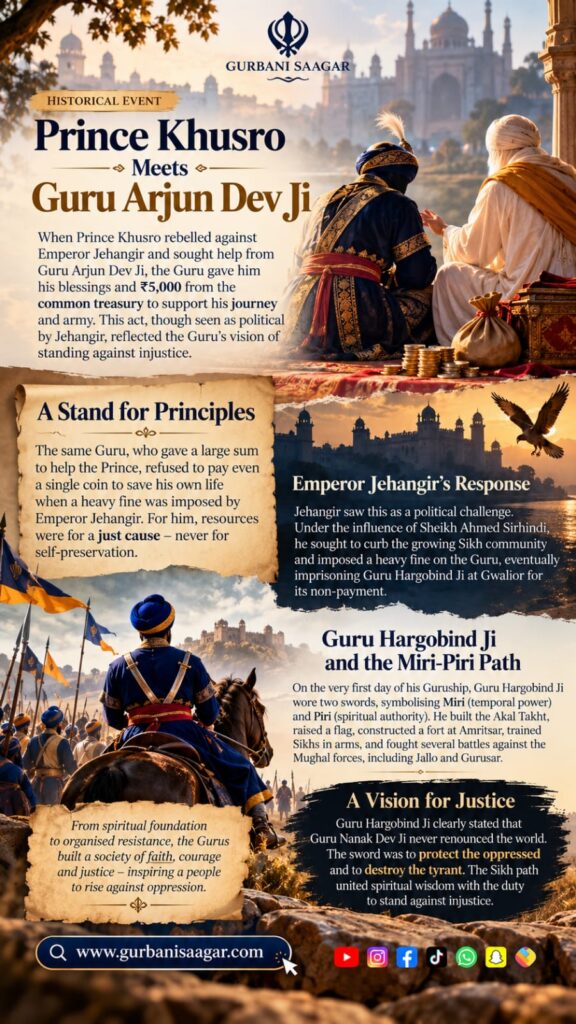
Jehangir came to the throne at Delhi. Khusro, his brother, who was considered to be of better temperament, training and aptitude, rebelled against Jehangir. His army did not make great headway, and he retreated to reorganise towards Lahore. There was a meeting between Khusro and the Guru. The Prince sought help and blessings, and both were given. Beni Parsad in his History of Jehangir records that the Guru gave Rs 5,000 to the Prince as help for his journey and the army.” Seen in the existing context the monetary help was very sizeable. The significance of this step, while it was never lost on Emperor Jehangir, has so often been missed by some historians. It is unthinkable that the Guru did not realise what would be the implications of this step, as naturally understood and actually interpretted by Jehangir. Another significant fact is that whereas the Guru gave such a large sum to the rebel Prince from the common treasury of the Guru, he refused to give even a penny from it by way of fine to save his own life, when it was imposed on him by the Emperor. In fact, he forbade even the Sikhs to make the payment to save his life. It is extremely meaningful to understand that while he considered the five thousand rupees he gave to Khusro to have been well spent, he would not give even a penny for his own self. It is, therefore, naive on the part of some historians either to misunderstand or to minimise the implications of a step, the meanings of which were clear to Jehangir. The Emperor in his autobiography distinctly expressed his ire at the event, and recorded that Sikhism was certainly a growth which he wanted to nip in the bud. Few emperors are concerned with quietist saints, and Moghal Emperors were always fond of Sufi Pirs and sought their blessings. Jehangir’s going out of the way to punish the Guru and, for that matter the growing Sikh society, was a distinct measure to curb the evident political potentials of the Sikh society. It is also evident that Sheikh Ahmed Sirhindi, the head of the Naqshabandi order, a revivalist of Islamic orthodoxy, who was in a position to judge the growing influence and expansion of the Sikh society, urged the Emperor to curb the development of the Sikh society in the area.” That a heavy fine was imposed on the Guru, is testified by Mohsin Fani who records that Guru Hargobind was sent to Gwalior as a prisoner for his father’s non-payment of the fine imposed on him.
“Before his execution Guru Arjun sent a message to his son that the time for starting open military preparations had come and that he should do so. Here it is significant to state that in the time of the Fifth Master, Guru Hargobind as a boy had been joining hunting parties involving requisite use of arms.
Beni Parsad, the renowned historian of Jehangir, declares that Guru Arjun’s was a political execution. The events of the time of the Fifth Master, and the positive steps and the tangible measures he took, make it plain that Guru Arjun raised a visible structure on the miri-piri foundations laid by Guru Nanak, and that the Sixth Master only continued further development thereof. As stated earlier, the conditioning and motivation about the socio-political and ideological independence of the Sikhs, had been developed by the first four Gurus. What is of profound significance is that Guru Arjun started the next stage in the growth of the Sikh society, and by his confrontation and martyrdom, strengthened the faith, determination and cohesion of the Sikhs for the struggle ahead.
From the time of the Sixth Guru the miri-piri complexion of the Sikh society became visibly and tangibly clear. On the very first day of his Guruship the Sixth Master used two swords as symbols of the miri-piri aspects of the Sikh society. The very significant fact is that in Sikh symbolism even for the piri, sword is the necessary insignia and not a rosary. For, it clearly defines and stresses that in Sikh ideology miri is an essential component of the Sikh spiritual system, and not that two separate concepts have been combined. The Sixth Master took a number of positive steps in the miri-piri development of the Sikh society. Evidently, in the initial stages he could not find men from among the Sikhs to impart training in the military arts. He, therefore, recruited mercenaries for the purpose. His two other steps were the construction of the Akal Takht with an additional flag on the premises of Harmandir Sahib, showing thereby that, whereas the activities appeared to be different, their integral fusion as a common source was essential. He also built a regular fort at Amritsar.
As stated above the Guru was imprisoned at Gwalior for his father not having paid the fine imposed on him. He was later released, but he continued with his military preparations and ventures. Henceforward, he instructed his Sikhs to don a sword and keep horses. He partook in hunting parties, and he gave, as before, full freedom for use of non-vegetarian diet. The Sikhs, as reported by historian Gupta, squarely established themselves as a state within a state’. Necessary recruitment of soldiers was done, and necessary wherewithals for an army were created.The first opportunity for a significant military venture of the Guru came soon after his release from Gwalior, when he helped Dharam Chand, a Prince of the Nalagarh Hindu state, to regain his throne. Before we go to the other military encounters of the Guru, let us record a clarification given by the Guru himself about the ideology of Guru Nanak. Goswami Ramdas, a saint from Maharashtra, happened to meet Guru Hargobind and expressed his surprise as to how he, who was riding a horse, keeping an army and wearing a soldier’s garb, could be a sadhu or a good successor to Guru Nanak. Guru Hargobind’s reply was clear and categoric, saying that Guru Nanak had never renounced the world, and that his sword was to protect the poor and to destroy the tyrant.” The importance of this statement is that it is an authentic elucidation of Guru Nanak’s thesis and spiritual man’s responsibility in the field of injustice and oppression, as laid down by the First Master, and as understood by his spiritual successor. In fact, it is a reiteration of what Guru Nanak had himself laid down in his hymns. Here again it needs to be stressed that Guru Hargobind’s understanding of Sikhism as defined by Guru Nanak, is perfectly authentic. For, it is Guru Nanak who in his hymns describes God as the Destroyer of the evil’, ‘the Saviour of Saints’, ‘the Slayer of the inimical’ and ‘An Anihilator of the demonical’.” As we are aware, the Naths were also surprised at the spiritual role of Guru Nanak, while he continued to wear the garb of a householder. Persons brought up in the Indian tradition like Sant Ramdas of Maharashtra, always express their surprise at the miri-piri thesis of Guru Nanak. Guru Hargobind started military preparations in right earnest. Mercenaries were employed and thousands of Sikhs trained as soldiers. On the basis of the organisational steps taken by the earlier Gurus, a sizeable and an independent socio-political system had been created.
Gupta writes: “The Sikhs came to occupy a kind of separate state within the Mughal state, the position of which was securely established by the fiscal policy of Guru Amar Das and Guru Arjun and his armed system”.” It is in this context that the confrontation with the Empire, initiated by the Fifth Master, was continued, and six battles with the Empire were fought by the Sixth Master. The battle of Jallo clearly suggests the climate and approach in the Sikh society towards the Empire. Jadunath Sircar writes that during a hunt the Sikhs clashed with the Imperial Forces about the possession of a falcon claimed by them and that in the end imperialists were beaten off with slaughter”.” The Sikhs declined to return the bird, because according to the rules of the game, it had legitimately come into their possession. The important fact is that they refused to accept the claim, or superiority of the claim of the Imperial troops on the basis of their sovereignty. It is a clear case where Sikhs, because of their own sense of political independence, declined to accept the sovereignty of the Moghal Administration, Two statements are significantly indicative of the Sikh self-understanding of their stand and their socio-political status. A contemporary of Guru Gobind Singh, Konkan later wrote about this incident saying that the Imperialists were claiming the bird (baj), but that they should forget about it, since the Sikhs were out to have the crown (taj) also from them (the Moghals). Another writer reports that this statement about snatching the crown was made by the Guru himself, when a Muslim tried to intercede and suggested to the Sixth Master that he would have the matter settled and the issue closed.” The incident and the consequent battle at Jallo are very significant of the politico-military defiance of the Guru. He not only refused to accept Moghal sovereignty, but also openly started to prepare his people for clash with the Empire. Later, more battles with the Moghal Forces from Lahore and Delhi, were fought by the Guru. According to Mohammad Latif, Mukhlis Khan who attacked at the head of 7,000 troops, was repulsed, defeated and killed. It is during this period that the town of Sri Hargobindpur sprang up, where the Guru built a mosque, evidently for his Muslim subjects and soldiers to offer their prayers. As in the case of the falcon, the Guru sent Bidhi Chand to recover his horses wrongly appropriated by the Moghal Governor. Since Bidhi Chand brought back the horses, the Governor Khalil Begh mounted an attack on the Guru. The Governor was defeated.
Another major battle with the Imperial Forces took place at Gurusar near Lakhi jungle, between Ferozepur and Bhatinda. In this battle alone, which the Guru won, 1,200 Sikhs lost their lives. In view of these continuous clashes with the Imperial Forces the Guru selected a site in the hilly area in Kehloor state and settled there.172.10 From the history of the times Gupta clearly concludes: “After 600 years of slavery he (the Guru) was awakening his fellow countrymen to the realisation that, irrespective of consequences, which were quite obvious, the people should rise against a cruel government to get their wrongs redressed”. “Guru Hargobind had a clear conception of the changing circumstances and had realised the necessity of playing an active role in the political life of the community”. “He certainly inaugurated a policy which was to lead the most downtrodden people slowly but assuredly to political and military advancement. The Guru created a revolution in the life of the Sikhs. Along with recitation of hymns they were taught the practical lesson of dharamyudha or holy war”. “In reality Guru Hargobind rendered a unique service to this country in showing the true path of deliverance from political bondage.
The large scale military preparations and organisation he created, his battles with the Moghal Forces, and, what is more important, the thought of political independence or sovereignty he promoted in the Sikh society, especially in the context of the Akal Takht, and the independent standard he raised at Harmandir Sahib, make it abundantly clear, that the Guru visibly and calculatedly furthered, both in theory and in practice, the miri-piri concept of Guru Nanak. But, as historians have recorded, he could do so only because of the foundations laid, conditioning done and structures built already by the earlier Gurus. This preliminary work of motivation and education of the Sikh society was very essential. Because in the over 2000 year old Indian tradition ahimsa, withdrawal, monasticism and celibacy had been established and accepted as religious values. It was, therefore, a colossal task indeed to discard them and make people accept, and make sacrifices for, the idea that it is the spiritual man’s responsibility to undo injustice and oppression even in the political field.
The Seventh Guru maintained an army and continued military activities. When the struggle for succession between Aurangzeb and Dara Shikoh started, the latter gathered his forces for the contest. Dara who was considered to be a person of liberal and tolerant views, called upon persons who were likely to support him. Dara was defeated by Aurangzeb, and he retreated to Punjab, the area of his Viceroyalty. The Guru met him at the head of a few thousand Sikh troops, and offered help. Dara seems to have despaired of his success, and gave up the contest. But Aurangzeb, like Jehangir, never forgot the offer of help by the Guru to Dara. It is significant that the Guru took a positive and voluntary step, when he knew full well that it was a contest for royalty, and as to what had been the result of a similar assistance rendered by his grandfather to Khusro, the then contestant for the throne. Yet, it is evident that the Guru did so in full consciousness of the likely consequences of the offer.And this could never have been done, if the Guru had eschewed political objectives. It is important to note that invariably the Gurus sided with the political party that in comparative terms stood for some semblance of fairness and tolerance.
As soon as Aurangzeb was secure at his throne, he called Guru Har Rai to Delhi. The latter sent his son Ram Rai. It is then that Ram Rai wrongly quoted a hymn from the Guru Granth to the Emperor, and the Guru discarded him for ever. Later, Guru Har Rai passed away in 1661. Similarly, the Eighth Master was also sent for by the Emperor. But before any meeting between the Guru and Aurangzeb could take place, the Guru passed away, while still at Delhi. The period of the Ninth Master is very eventful. Aurangzeb intensified his bigoted and intolerant activities against non-Muslims. Large scale demolition of Hindu temples, execution of opponents and conversion of Hindus to Islam, particularly in Kashmir, took place. Two facts about the period of the Ninth Master are important. The Emperor was informed that the Ninth Master was creating a new nation with the object of a rebellion against the Empire. Thereafter, the Emperor conveyed a message to the Guru that if he he gave up his political activities, he would get Government grants for his prayers and preachings.” The political implications of the rejection of this offer, were too obvious to the Guru, and yet he did so. The Guru toured Punjab in order to relieve peoples’ suffering and raise their morale. In fact, when the harassed Kashmiri Pundits approached him for advice and help, he gave them a solemn assurance.” The subsequent story of his being called to Delhi, and of his execution is well-known. These two facts make it plain that not only political objectives and help to the oppressed people, were within the religious purview of the Gurus’ system, but they actively, militarily and otherwise always pursued those interests with a view to confronting injustice and oppression. And for this purpose they staked everything and organised and led the Panth to do so. The above is the story of Guru Har Rai and Guru Tegh Bahadur, seemingly peaceful Gurus, who not only made military preparations, but distinctly and openly made political moves that provoked intense hostility towards their persons and the Panth.
The period of the Tenth Master is of open, continuous and mounting military activities and clash with the Empire, the Moghal Governors and their associate Hill Princes. In all he fought about twenty battles involving the loss of thousands of his men, his four sons, his mother and extreme personal hardship and suffering. He accomplished in his life time the epitomic work of creating the Khalsa and its organisation, with the clear objective of fighting injustice and oppression. This he declared in his speech at the time. Facts and events clearly suggest that political objectives were significantly present because of the oppressive Moghal policy of the period. The Guru built a sizeable military force, recruited mercenaries, and invited the Hindu Hill Princes to join him in order to overthrow the oppressive Empire. Because of the liberating policies of the Sikh Panth, the caste-ridden Hindu Princes not only declined to side with him,” but invited or fought on the side of the Moghal armies against him. That the objectives of the Guru were religious and just, is clear from the fact that a Muslim Pir, Budhu Shah, sided and fought on his side, involving the loss of his two sons and hundreds of his Muslim followers.” This marvellous event makes it glaringly clear that while the struggle of the Guru was political, it was considered by all good persons just and fair, and in the interest of the people as a whole.
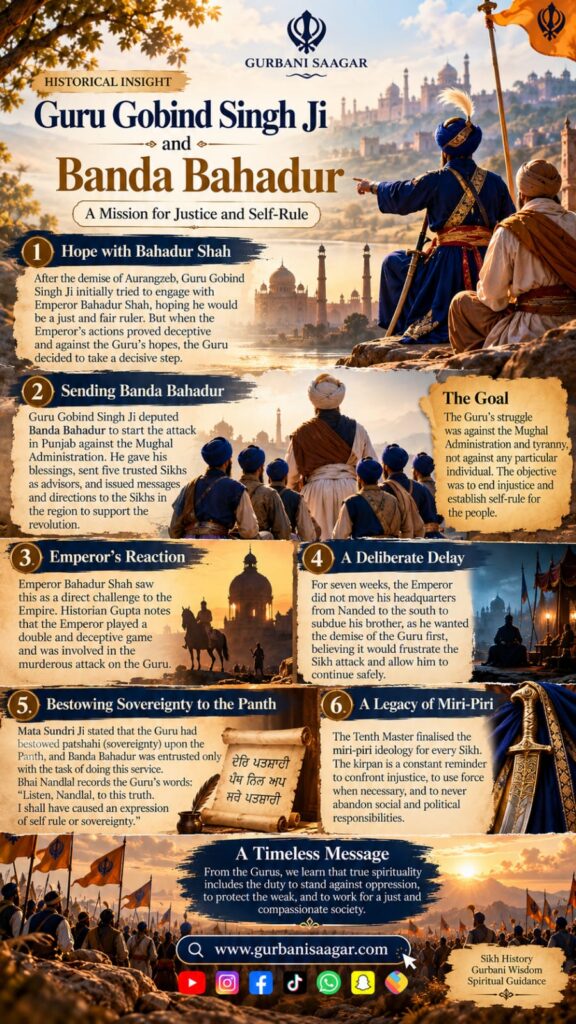
Even after the demise of Aurangzeb, the Guru did try to Bahadur Shah, in the hope that he would prove a fair ruler. But when the Emperor’s conduct belied his hopes, he deputed help Baha Banda to start the attack in Punjab. He gave his blessings to Banda Bahadur, sent five of his trusted Sikhs as Advisors with him, further giving messages and directions to the Sikhs in the state to support the revolution. The significant fact is that the Guru’s attack was against the Moghal Administration, and not against any particular person. The Guru’s disappointment was with the Emperor, who according to historian Gupta, had been playing a double and deceptive game and was involved in the murderous attack on the Guru. For, he clearly felt that the Guru’s move of sending Banda and his army to the North was an assault against the Empire. Significantly, for seven weeks the Emperor did not shift his headquarters from Nanded further down, to subdue his brother, until the demiso of the Guru, an event which, he felt, would frustrate the Sikh attack, and enable hin to safely continue his march to the South.”
The political objectives of the Guru are also evident from the statement of his spouse, Mata Sundri, when she stated that the Guru had bestowed patshahi (sovereignty and rule) upon the Panth, and that Banda had only been entrusted with the task of doing this service to the Panth.
(Bande ko khijmat dei, dei patshahi nahi; Dei patshahi panth nij ap sache patshahi).
This makes the objective of sending Banda, his advisors and army to the Punjab very explicit. This is also supported by Bhai Nandlal’s record of the Guru’s emphatic statement in his Tankhahnamah, saying, “Listen, Nandlal, to this truth. I shall have caused an expression of self rule or sovereignty”.” It is significant that after the success of Banda in the Punjab and his declaration of self-rule there was no difference of opinion or policy as between Banda and his deputed advisors and Sikhs.The differences arose only when Banda was considered to have departed from Sikh practices, meaning thereby that whereas establishment of self-rule was a part of the Guru’s mandate and within the ambit of his policy, it is Banda’s supposed departure from Sikh practices that led to the sikhism.
The above is a brief record of the miri-piri development in Sikhism in the Guru period. But the most important fact is the insignia the Tenth Master finally prescribed for every Amritdhari Sikh as an essential part of his wear. The kirpan constantly reminds the Sikhs of three things. First, of his responsibilities to confront injustice and oppression in the political field, both as an individual and as a member of the Sikh society. Second, that use of force, to the extent necessary, is permitted. The third reminder is equally significant, namely, that the Sikh society should never shirk its socio-political responsibilities, nor decline into monasticism, withdrawal or asceticism. The prescribing of this insignia, virtually a Hukamnama (order) by the Guru is indeed an act of deep historical insight and vision. For, it has been a historical experience that religious societies that started with clearly accepted socio-political responsibilities, later in their leaner periods, declined into pacificism, withdrawal and monasticism, forgetting their social responsibilities. And, it is this responsibility that Guru Nanak emphasised, while taking to the life of a householder, and combining spiritual life and empirical life.
GURU PERIOD: AN OVERALL LOOK FROM THE MIRI-PIRI ANGLE
Let us have a look at the Guru period from the angle of miri-piri concept the Gurus introduced. Earlier in India religion unmistakably involved withdrawal, sanyasa, ascetic practices, ahimsa, celibacy, and the consequent downgrading of women and householder’s life. Guru Nanak’s colossal task was to change this over-2000-years-old religious tradition. He could very well have been misunderstood, if he had started abruptly, crudely or just theoretically. The primary question which the Naths raised with the Guru was as to how he claimed to be leading a religious life, while retaining the garb of a householder’s life. Such die-hard prejudices and practices could not be removed overnight. Guru Nanak spent almost a whole life, preaching far and wide the essentials of his system. Hardly any religious leader of his or earlier times travelled so extensively. Yet, he also laid the firm foundations both of its entire theory in his hymns and of its structural and organisational framework on the ground. People had to be weaned away from their old ideas and habits. The basic task was not only to create a new ethos, but also to convince the people that the path he led was indeed spiritual in its true sense. Accordingly, in the time of the first four Gurus, the emphasis was on conditioning and education of the Sikh society in the new mission and goals.
The period of the Fifth Master is clearly the one when the climb on the high road of the miri-piri course was begun. Muslim contemporaries like Mohsin Fani and the Moghal Administration, became fully aware that the Sikhs had developed a political potential, and posed a serious problem to the Imperial policies. For, the Fifth Guru started the collection of daswandh and used it for political organisation and objectives. The Fifth Guru’s periodical Sikh gatherings were considered regal in their size and operation. He initiated confrontation with Delhi, and by his martyrdom strengthened the will of the Sikh society to struggle and sacrifice. The Sixth Guru’s militancy and battles were open enough. The Seventh Master never faltered when the opportunity came to offer help to Dara, nor did the Ninth Master give up his military and political activities, even when the Imperial offer came and the risk in declining it became evident. Every time the road to martyrdom was chosen voluntarily. The Tenth Master not only made his military confrontation open and continuous, but he also made two monumental landmarks. By his Amrit system he finalised the structural framework of the Panth, ensuring that it would not slip back into withdrawal and pacificism. Second, by his dispatch of Banda expedition to Punjab, he finally mounted the assault on the Empire.
Yet, how difficult it is for persons with a pacificist religious background, or bent of mind, to accept the ideology of Guru Nanak, is evident from the fact that not only Naths and Sant Ram Das, but even today persons given to the pacifist or soft life of the time, or impervious to poverty and distress, are disinclined to accept the bold miri-piri logic of the Gurus. On the other hand, the Gurus have been very outspoken and clear about it. Guru Nanak emphasises that the only path of spirituality was the one of love and, if once chosen, one should waver not. The same is the clear message the Fifth Guru gave to Bhai Manjh, when he asked him if he should follow Sakhi Sarvar or be a Sikh of the Guru. The Guru replied that he better continue with the soft life of being a Sakhi Sarvaria, because as a Sikh his whole wealth and life would be at stake.” And, exactly the same message was given, and the undertaking obtained, when the Tenth Master administered Amrit to the Five Beloved Ones or Piaras. In each case the path was of love, and the commitment demanded was total. And what total commitment means has been amply demonstrated by the Gurus themselves in their sacrifices, deeds and martyrdoms, which hardly have a parallel in human history. It is just naive to say that the last over 140 years of the Guru period were just incidental or accidental. In fact, they record the most indelible imprints of the Guru period and an incontrovertible interpretation of the Sikh thesis which Guru Nanak had completely embodied in his hymns and the Fifth Master had finally compiled in the Adi Granth in 1604 AD. The subsequent tempestuous 104 years of the lives of the Gurus, which were full of sufferings, and creation of the Khalsa, become evidently incongruous, if any other interpretation of the Sikh thesis is suggested.
SOME CRITICISMS ANSWERED
There have been a number of criticisms of the historical view presented by us. A major criticism, mostly from scholars with a pacificist or dichotomous religious background, is that a doctrine of love of God cannot be reconciled with the use of force or war. This mental inhibition is understandable from votaries of dichotomous or pacificist religions. Jadunath Sircar, Mahatma Gandhi and Tagore have been critical of the role of the Tenth Master. Similarly, Toynbee frowns upon the work of Prophet Mohammed for his militancy. These scholars ignore that actually it is the doctrine of love that provides the compulsion to confront injustice. Evil is a fact of life. The question is how to undo it, and who is responsible for doing so. In a whole-life religion the answer is clear. Since God is himself the Destroyer of the evil and the demonical, the seeker, as his instrument, must make every effort to fight out oppression, as a religious responsibility. Injustice, as is well known, is greatest in the political field. The man of religion, imbued with love, cannot remain indifferent or step aside, when injustice is done within his social sphere. The next issue is whether that confrontation should remain confined to the use of pacificist means only or should include resort to the use of force as well. The twentieth century has made the answer to this question quite clear. After the start of the Second World War, votaries of pacificism sought the advice of Mahatma Gandhi, the apostle of non-violence. But he had no answer, and felt so frustrated and baffled, that he thought of committing suicide. Later he himself suggested participation in war for the Allies, in case Britain agreed to grant autonomy to India. It is also well-known that after 1947 he blessed the dispatch of Indian forces to Kashmir to repel Pakistan-backed intrusion by tribals. H.M. Seervai, the greatest constitutional lawyer of India, concludes, “There is little doubt that Gandhi used non-violence as a political weapon, and was prepared to support or connive at violence to secure political goals.
Bertrand Russell has been another known pacificist who even suffered imprisonment for his views during the First World War. But after the Second World War the same Russell suggested that in order to avoid the appalling disaster of a possible Russian victory, threat of force, or even the actual use of force, should be employed against the USSR, before it could develop a big stockpile of atom bombs, and become a threat to the West. In short, this shows the bankruptcy of pacificism in human affairs, if injustice and oppression have to be confronted. Pacificism is all right where the objective is individual salvation, and goes well with all systems of withdrawal.
Some scholars are fond of quoting the hymn of the Guru,
“Raj na chahon mukt na chahon man preet charan kamlare.”
Invariably the meanings and message of the hymn are distorted. What is rejected are power, pelf and the pride and glory thereof. Guru Nanak declared that Sikhism is a path of love, and the Gurus for over hundred years waged a war against oppression and the intolerant state, involving the death of thousands of Sikhs and their own martyrdoms. They were certainly following the compulsions of the path of love. Bergson has clearly stated that in the case of a mystic of activity, his love of God is transformed into God’s love for all men.” It is both the love of God and man that compels the gurmukh to fight for a righteous cause. Similarly, the story of Abu Ben Adam demonstrates that in God’s system the love of man is synonymous with his love for God. True, scholars from pacificist religions have their own compulsions. But, as stated above, love of man, help to a neighbour under attack, and confrontation with evil on the one hand, and pacifism, in the face of injustice or oppression, on the other hand, are a contradiction, and connot often go together. It is also incongruous to suggest that this interpretation of the hymn, while it can justify struggle with oppression, means that after the oppressor is eliminated, the religious man should withdraw from the field and leave another manmukh to occupy the seat of power. The history of the Guru period does not suggest any such withdrawal from social responsibility. In fact, during the last hundred years the Sikh Gurus not only were administering large scale economic and socio-political organisations, and punishing wrong-doers, like Masands, but were undertaking every kind of social responsibility almost impossible to discharge in a life time.
Another ideological objection that has been raised is the couplet in the Bachitar Natak ‘Babeke Babarke Dou, ap kare parmesar sou, Deen Sah inko pehchano, duni pat unko anmano. This is interpretted as the Guru virtually saying, “Render unto Caeser what is Caeser’s.” First, as is known, the authenticity of the verses is in doubt. It is unbelievable that the Tenth Master who all his life confronted the Moghal Administration, fought twenty battles, invited the Hindu Hill Princes to join his struggle to supplant the intolerant rule of Aurangzeb, and dispatched Banda to Punjab, could ever write such a couplet conceding temporal authority to him. Second, even the interpretation and translation of the words as explained by Kapur Singh and Jagjit Singh,” have been incorrectly done. The couplet is just a factual statement that both the house of Babar and the house of the Guru are the creation of God. There is nothing in it to suggest that the Guru directed the Sikhs to recognise the house of Babar as such, while all his life he himself had been fighting that house. It is just a couplet to mean the omnipotence of God as the Creator of everything. The translation of the word ‘pehchano’ to mean the word ‘recognise’ is obviously incorrect. The word means only a statement of the position of the two houses as it was, and does not at all imply any recognition thereof.
It has also been suggested that the Guru sent Banda with the Advisors and the Sikh Army only to negotiate with or to subdue and punish Wazir Khan, Governor of Sirhind. The suggestion is a bit naive. Sending the army with Banda and messages to the Sikhs to rally round him, can hardly be considered consistent with Banda’s role as a negotiator. The Guru had himself tried to negotiate with Bahadur Shah, who alone was in a position to make a settlement, and came to the conclusion that he was not inclined to do so. The circumstances following the negotiations and the step taken by the Guru are clearly indicative of their failure. On his part the Guru sent Banda to launch the attack in Punjab. Bahadur Shah obviously, resented the Guru’s move and deceptively tried to send the Pathans to assassinate the Guru.” It is just absurd to suggest that Wazir Khan was in a position to negotiate anything, or that, if subdued or destroyed, the Emperor would remain unconcerned; or that Banda or the Guru would later take orders from Bahadur Shah to appoint a new Governor of Sirhind after Wazir Khan’s elimination. Hence, as also confirmed by Mata Sundri, Banda had been deputed to establish the raj of the Panth.
It has also been suggested that although the Gurus kept armies, and fought battles for over a hundred years, they never carved out any area for themselves, and had no political consideration in view. The suggestion appears quite meaningless. The entire Punjab was under Moghal rule. The question of carving out a principality for the Guru could arise either by supplanting the Moghal rule or by accepting their suzerainty. The question of the second possibility could not arise, and it is to undo the unjust, intolerant and oppressive Moghal rule, that the Gurus had been fighting throughout.
Another scholar has argued that the use of force permitted by the Guru is only for the purpose of defence. Confusion about the meaning of defence in human and military affairs is common. The basic question is about oppression and injustice, and how to undo them. What has to be defended is peace, freedom and justice. Thus, military activity of every kind in support of justice is defence. As such, the question of defence or offence is irrelevant, the form of operation being just a matter of strategy. The maintenance of thousands of soldiers, including employment of mercenaries, waging of scores of wars by the Gurus, and the dispatch of Banda to Punjab from Nanded can in the common terminology hardly be called defensive, except in the sense that all such operations were in defence of righteousness. It can never be suggested that the Gurus waged the wars and made the attacks to save their person or property. It is simply unthinkable that the Gurus kept army just for any personal or parochial purpose and not to secure justice and peace for the people, and to save them from oppression or conversion as had been explained by the Sixth Master to Sant Ram Das.
It has also been argued that as the Guru Granth never lays down any rules for civil or political administration like Shariat in Islam, it means that the Gurus never contemplated any political role for the Sikhs. The argument is far from sound. As noted already, the Gurus themselves had been creating and managing large scale socio-political organisations and armies. That they conducted their administration with love and justice, is evident from the extreme devotion they inspired from the Sikh as well as non-Sikh forces. It is this sense of fairness and spiritual purity in their conduct and objectives that led Budhu Shah to join the Guru’s forces, involving the loss of his sons men. The second part of the issue is that civil rules and practices are always dated, and never universal or eternal. These demand adjustment to ever changing socio-economic conditions. Therefore, for a spiritual man to prescribe rules of civil life can, quite often, become an embrassing handicap for his followers. We are well aware that rules of the Shariat and like practices that had been laid down in Judaism and Islam, both whole-life religions, have sometimes become a limitation orincongruous in changed circumstances. It shows, indeed, the vision and wisdom of the Gurus that while they clearly laid down basic principles of ethics and morality to be followed by the Sikh society, they avoided laying down civil rules that could in the course of time become restrictive or a hurdle.
In modern times persons with background of social sciences are very fond of suggesting environmental or social factors as the cause of religious or historical developments. It has been argued that since Jats of the area became the Sikhs of the Guru, and since Jats are known for a militant temperament, it is concluded that militancy in the Sikh society was the result of their infiltration in the Sikh ranks. Jagjit Singh in his book’The Sikh Revolution’ has dealt with the subject at length, and exploded the entire basis of this argument. Factually the position was that at the time Guru Hargobind took to militàncy, the Jats were in a minority in the Sikh society. Among the prominent Sikhs listed by Bhai Gurdas, the Jats formed a small fraction.” It is well known that Baba Budha, a Jat, and Bhai Gurdas, the two topmost Sikhs, remonstrated with the mother of the Guru to dissuade him from the risky path. But since in the Sikh society final decisions had to be made by the Guru, he not only continued with his policy, but what is most significant, he even recruited numerous Muslim mercenaries to train the Sikhs in military arts. In fact, the adversaries of the Guru ridiculed the strength of the Guru’s army, because most of its constituents belonged to low castes despised by the Muslim adversaries who were proud of their own race and competence in the art of war and militancy.” It is understandable that later the Jats joined the Sikh fold because of the military needs and leadership of the Gurus. It is, thus, ridiculous to suggest that the Gurus took to militancy because of Jat entry among the Sikhs. The fact is that, the Guru had to employ mercenaries, because of paucity of available recruits in his own ranks.
Social science scholars also sometimes give syncretic explanation of militancy in Sikhism. For, they are disinclined to accept ideological reasons for it. The syncretic explanation has been discussed and discarded both by Jagjit Singh” and James Lewis.” The suggestion is that militancy was accepted because of prevalence of Shaivism and Devi worship in the Hill areas or because of Islam. So far as Devi worship in the Shivalik Hills is concerned, the argument has obviously no basis. Guru Hargobind raised his army, fought all his six battles and built the Akal Takht and Lohgarh Fort at Amritsar in the Plains of Punjab, long before he retreated to the Hills. And, Devi worship and Devi temples were too insignificant in the plains of the Punjab so as in any way to influence the Guru or the Sikhs. In fact, because of the Sikh ideology and their conditioning, the Sikhs had hardly any faith in the validity of Devi or Siva worship. It is also well known that the Hindu Hill worshippers of the Devi declined to join the Guru in his struggle against the Empire. Rather, they supported the Moghal forces against the Guru. Similarly, the influence of Islam is out of question, because Sufism, the principal missionary wing of Islam, was itself non-militant and never raised any voice, much less an organisation, to oppose the oppression of the Moghal Administration.
ACHIEVEMENTS OF MIRI-PIRI SYSTEM
The achievements of Guru Nanak’s miri-piri system are in many human fields revolutionary, monumental and abiding. Jagjit Singh in his three books, ‘The Sikh Revolution’, ‘Perspectives on Sikh Studies’, and ‘In the Caravan of Revolutions’, has dealt with the subject at length, and shown that, although burdened with the tradition of life-negating ideology and caste-ridden social structure and ethos of the Indian society, the Gurus assiduously weaned away the Sikh society from it by creating among them a new set of values and goals.
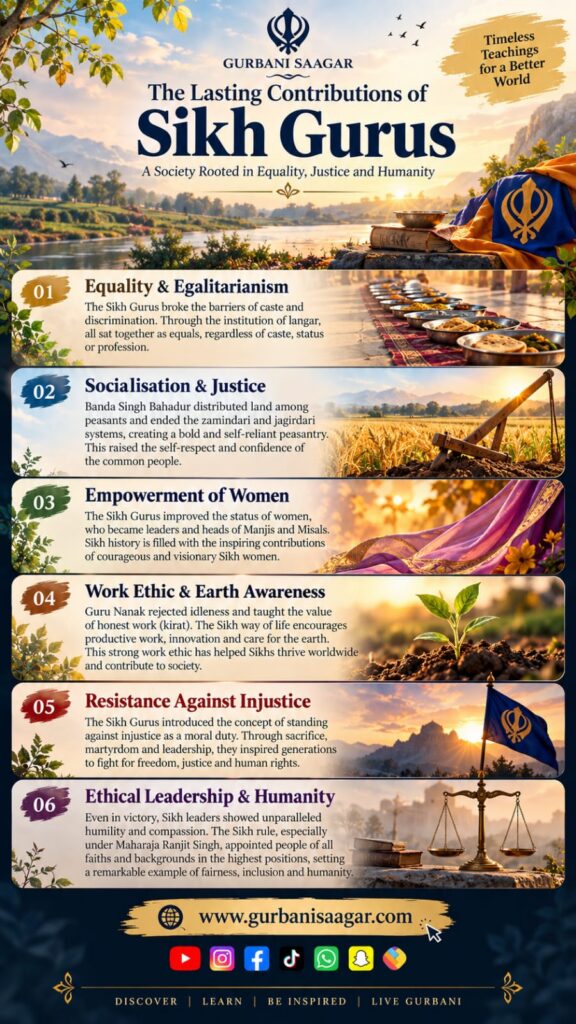
Equality/Egalitarianism:
First is the sense of equality and fraternity the Sikh Gurus brought about in the social field. By the essential institution of langar they broke all barriers and discriminations arising from the caste ideology and the concept of pollution. In the Guru period and even later in the eighteenth century, the elimination of all restrictions concerning commensality and social intercourse stood removed. The supremacy of the two higher castes was completely eliminated as also the stigma against the lower castes concerning mobility of profession. Upto the eighteenth century there was no Sikh leader except from the two lower castes, and Sikhs from the so-called higher castes willingly accepted their leadership.
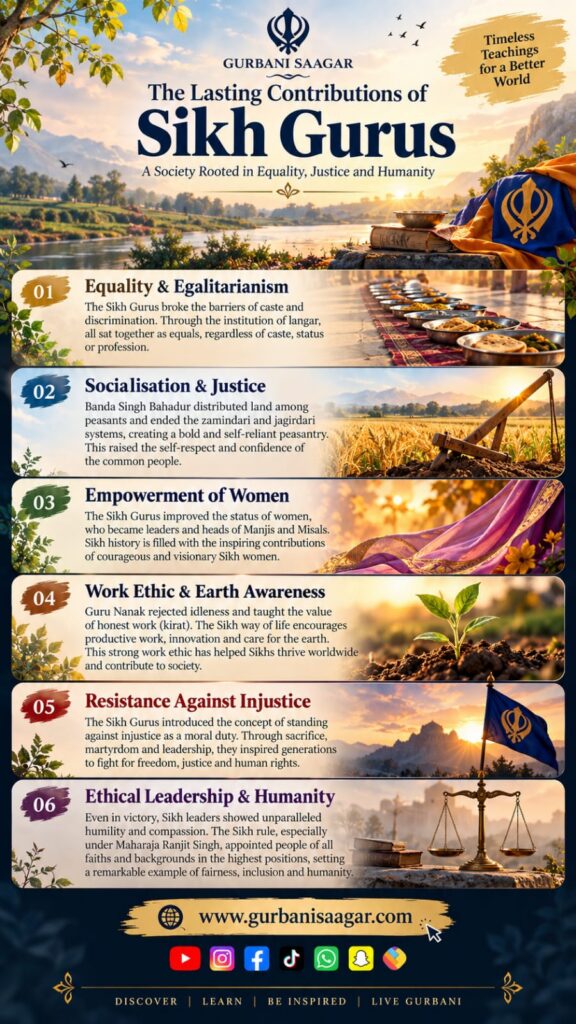
The first Sikh leader who struck a coin was Jassa Singh, a Kalal considered to be a low Sudra subcaste, who was never shy of proclaiming his caste on the coin he introduced. Even from the other Sudra castes there were respected and distinguished leaders in the Sikh society, like Jiwan Singh and Jassa Singh of Ramgarh. The lowest castes were recruited to the Sikh forces without any stigma or discrimination. The self respect of these lower castes was raised to a level that they had no sense of inferiority vis-a-vis the higher castes. It is not a small contrast that unlike Hindus, the Sikhs have never been led by Brahmins either in socio-political or intellectual fields.
Socialisation: The greatest measure of socialisationwas the step Banda took after his victory, namely, the distribution of land among the peasants and elimination of the zamindari and jagirdari systems. He created a bold peasantry.It is this great step of socialisation which raised permanently the sense of self-respect, self confidence and self reliance of the masses in the Sikh society. Neibuhr, the distinguished Christian theologian of the century writes: “Because of evil in man and in society, Christian political action called not simply for love, but for an attempt to give each group within society power to defend itself against exploitation by other groups. Although relations between individuals might be a matter of ethics, relations between groups were a matter of politics.” What the Christian theologian suggests as the necessary corollary of love, was meaningfully done by the Sikh religion to check human tendency towards exploitation and oppression of the poorer sections of society. Similarly, Jagjit Singh in his book ‘In the Caravan of Revolutions’ has stated that whereas the French Revolution never changed the class structure, nor raised the power or social level of the lower strata, the Fourth Estate of the Christian society, and power continued to be in the hands of the upper middle sections of the French society, it is only the Sikh religion that permanently broke in the Punjab the social stratification in order to raise the level of the lowest classes in the social structure. The status of women was improved, and they became leaders and heads of Manjis and Misals. In the history of man such a large scale change in the social and power structure has hardly ever taken place. In fact, many of the social and political developments and problems in the Punjab and the Sikh society, can be understood only in the context of such achievements of the Sikh religion.
Earth Awareness
It is Guru Nanak, who condemned the idleness of the yogis, their vow to shun economic activity, and the general habit of withdrawal. The Gurus by their ideology and personal example and leadership, created the work and sustenance habit in the Sikh society, which has since then become its established feature. Accordingly, in the Sikh society not to do any productive work or to live on begging is considered parasitism and a stigma. It is this cultural trait that enables the Sikhs to adjust and live gainfully as acceptable migrants in most foreign societies. It is because of their work habit and sense of adjustment, innovation and pragmatism, that not only were they the first in the East to accept and adopt the wherewithal of the Green Revolution, but today they regularly produce each year enough grain to contribute over 60% of the food reserves procured by the Indian Government for distribution among deficit areas of the country.
Reaction against Injustice and Oppression
Guru Nanak is the first man of God in India, who introduced the concept of resistance against injustice as a moral value for the man of religion. It was by their martyrdoms and leadership that Guru Nanak and his successors created, among a stagnant pool of population, a new spirit, cohesion and zeal that enabled them to supplant in Punjab a mighty Empire, and to stop once for all a thousand-year wave of invasions from the North-West of India. Individual leaders have been galore in India and elsewhere, but rarely have the masses been fired with such a spirit for justice and liberty, as was created by the Sikh Gurus. The marvellous work of Guru Gobind Singh against tyranny has been epitomised in a single couplet of contemporary Sufi mystic Bulleh Shah, who sang his tribute to the Tenth Master, ‘I neither speak of the past, nor do I speak of the future, but I speak of the present; but for Guru Gobind Singh, all the Hindus would have been circumcised i.e. converted to Islam.
Despite a price on each Sikh head, and repeated reports that all of them had been eliminated, the Sikh masses rose, on the one hand, to uproot the oppressive administration in the area, and on the other hand, to repel the invaders periodically Swarming India, for loot and booty, from the North-West.
What is important is the acceptance in the society, of a new set of values, and to cultivate its capacity to make sacrifices and suffer for the cause of justice. The role of the Sikh society in the fight for liberty in the eighteenth century is well recognised. Their contribution to the cause of freedom is equally outstanding in the 20th century. The first two rebellions against the British, the Kuka Rebellion and the Ghadar Rebellion, were almost wholly manned by the Sikhs. While the Sikhs form only 2% of the Indian population, during the struggle for Indian Independence, of the 121 persons hanged, 2644 imprisoned for life, and 1330 massacred in the Jallianwala Bagh protest meeting, 93, 2047 and 799, respectively, were Sikhs. Again, of the soldiers who in the early forties, fought under Subhas Chandra Bose in the Indian National Army, 60% were Sikhs. In 1975, when the Prime Minister, Indira Gandhi imposed the Emergency Law, curtailing all human rights and liberties, the Sikhs were the only people who organised, sustained and managed from the Golden Temple, Amritsar, a peaceful struggle against this invasion on all human freedoms. It involved imprisonment of over 40,000 Sikhs, when in the rest of India, not even one third of that number offered, as a protest, voluntary arrest. It is necessary to state that movements initiated by the Sikhs against the state were executed from the precincts of Darbar Sahib, Akal Takht, wherefrom they drew their inspiration and strength. It is regarding this struggle of the Sikhs that Ms Vijayalakshmi Pandit, sister of Jawaharlal Nehru, said, “Punjab which has always been in the forefront of resistance of oppression, kept its colours flying, during the Emergency also. It was in Punjab and Punjab alone, that a large scale resistance was organised against it. The worst thing that happened during the Emergency was that a brave nation was frightened into submission, and nobody spoke, except in hushed tones. In Dehra Dun, where I was, I hung my head in shame, and wondered, if this was the Bharat for which we, the freedom fighters, had suffered. Even those, not actually in prison, were no less than in jail. Only in Punjab the Akalis organised a morcha (protest) against this. Punjab’s lead in such matters should continue.”
Sikh Ethos
A very important fact is the ethos the Sikh society and its leaders displayed, when they were in power. Qazi Nur Mohammed, an official reporter who came with the invading armies of General Abdali, reports that while the valour of the Sikh soldiers and their courage are undisputedly outstanding, what is extremely significant about the Sikhs is their conduct towards the vanquished. For, the Sikh soldiers neither loot, nor molest women, nor fire upon or attack a fleeing soldier. In fact, the self-discipline and ethical level of the victorious Sikh soldiers have not been achieved even in modern times.
An equally significant fact is the magnanimity displayed by the Sikh Administration during the time of Ranjit Singh. Even though Sikhs had suffered the severest persecution at the hands of the Muslim Administration, in the 18th and early 19th centuries, the Sikh Rule never showed any discrimination for recruitment in the army or civil administration against them. In fact, they enjoyed both in the army and the ministries the highest and most trusted positions. It is, due to this unrivalled conduct of Ranjit Singh that in the Anglo-Sikh Wars the Muslim soldiers fought the British with the same zeal as the Sikhs.
It was because of caste discrimination, acute caste consciousness, and professional immobility that the contemporary Rajput and Mahratta rulers could never develop any sense of cohesion or nationalism among their people as a whole. In these administrations, feudal and jagirdari systems were continued, and caste ideology and its exploitative and other manifestations were upheld. The social stratification was so strong that a Rajput scorned to work on land, because if he did so, he was denigrated in social status. In Maharashtra apart from the fact that the Ministers were Brahmins, there was prohibition against the entry of untouchables on the roads during most of the day, lest their shadow should pollute the higher castes. It was a standing state order that caste and Shastric regulations should be adhered to in the administration of justice as between different sections of the people and that no innovation or departure should be made in their enforcement. It is well known that pogroms against Jews and ghettos were a regular feature in contemporary Christian states in Russia and Europe.
As against this, Ranjit Singh gave ample grants to Muslim and Hindu religious places, and there were no communal tensions or clashes in his State. It is also significant to state that Ranjit Singh spent about 10% of his revenue for beneficient causes and religious grants. No attempt at religious conversions was ever made. His beneficence went to the extent that he never gave a death sentence to anyone including those guilty of attempts on his own life.”
What we seek to emphasise is that although change in ethical values of the masses is a very slow process, especially in traditional cultures, it is in this field that the Sikh society showed a distinct and radical change, both in its external and internal behavior, moral discipline, social conduct and sense of responsibility for maintenance of human rights and justice, and towards other contemporary societies. The important fact is that the change was significant at the mass level.
CLASSIFICATION OF RELIGIONS
One of the major reasons for misunderstanding and misinterpretting Sikh ideology is the ignorance of some scholars, especially those drawn from the field of social sciences, about the basic classification of the religions of man. Broadly speaking, ing, religions may be divided into two categories, namely, life-negating, fe-negating, and life-affirming. In the case of life-negating religions, the world is deemed to be mithya (unreal or an illusion) or a place of suffering, or man is considered an unwanted combination of the spiritual and the empirical elements, which has to be disentangled. In all these cases the institutions of withdrawal, sanyasa, asceticism, celibacy and the downgrading of women are ideologically accepted and recommended. methods for pursuing the spiritual path. In such religions, for that reason, monasticism, nunneries and pacificism appear. The salient fact displayed by the religious history of man is that practically all these institutions, and values, being correlated, go together. The goal is personal salvation (moksha), union with or merger in the Absolute, or an eternal life of the soul.
In the second category, evil in life is considered a problem, and the man of religion, while taking full participation in life, seeks to battle with the forces of evil. In these cases God is considered to be Altruistic and Immanent, and to have a will directing the world. The goal of the man of religion is, thus, to live and work as an instrument of God’s Will, and in that pursuit to accept total social responsibility. The seekers are supposed to live the virtues described as attributes of God. They do not withdraw from, or reject life or any part of it. For them life is a single whole, and cannot be compartmentalised. In these religions the emphasis is on family life and social responsibility which includes confrontation with evil. As such, love, moral life, freedom, justice, and equality of man, become primary values for the spiritual man, and simultaneously, what is contrastingly significant, the institutions of withdrawal, sanyasa, celibacy, monasticism and ahimsa are rejected.
Jainism and most other Indian systems are typical of the first category, in which the related values and institutions mentioned above, are fully accepted. Once the seeker reaches the final stage of spiritual goal, kavilya, there is no return toife with which connection is permanently severed. Similarly, the Videhi Mukta Thas no role to play in the world. The important fact is that, except in the case of Sikhism, which belongs to the other category, all these methods and values, accepted and used in the first category of religions, have been an integral part of the Indian cultural and religious heritage for the last over 2500 years.
Judaism, Islam and Sikhism belong to the other category. The revelation of God to Moses straightaway directs him to make an attack on the land of Canaanites. Moses and his men were reluctant to move, but God revealed, “My angel goes before you and brings you to Amarites, Hittites, Perizzites, Canaanites, Hivites, and Jevusites, and I annihilate them”. “So God led the people roundabout by way of the wilderness at the Sea of Reeds”. “The people may have a change of hearts, when they see war and return to Egypt”.” Further, the Law of Punishment revealed to Moses says, “The penalty shall be life for life, eye for eye, tooth for tooth, hand for hand, foot for foot, burn for burn, etc. “” The Torah, apart from prescribing the rules of war and civil life, lays down the Ten ethical Commandments, as also regulations for sacrifice and rituals. David and Solomon were celebrated kings of their times, and the Jewish prophets saw to it that they worked according to the ethics prescribed in the Torah. The Torah is an integral part of the Bible. The important fact is that the ethical commandments laid down over three millennia back embody certain fundamental laws of morality, which are valid even today. In short, it is an ethically sound miri-piri system that sanctions the use of force or war for a righteous cause, or for the purpose of God. It is obvious that withdrawal, monasticism, celibacy, etc., are nowhere prescribed. Torah continues to be the spiritual guide of the Jews, and from the time of Moses to the sixth century BC, no variation was suggested by the prophets, or was practised.6.5 It is for emphasis that every religious system has its logic and corollaries which lead to congruous institutions and values. Another important fact is that in revelatory religions basic ideology is laid down at the very start, and consequently, it is in the laid apart of the religion that foundations of the system are laid and proclaimed. The history of Judaism and Islam makes this point very explicit. Further, all whole-life religions accept the family system, and are social in their constitution and character. Being life-affirming, the emphasis is on a life of love and virtue, and not on adopting ascetic practices, or creating monastic institutions. Pacificism is rejected. Significantly, while the acceptance of certain values and institutions is natural and necessary, simultaneously the rejection of contrary institutions is also considered equally natural and desirable. An important corollary of the whole-life religions is the institution of martyrdom.
Here it is extremely necessary to understand that it is Guru Nanak who calls spiritual life a ‘game of love’, organises a society, and rejects asceticism, withdrawal, celibacy and ahimsa. In fact, the words hukam and raza meaning the Will of God, were taken by him from the Muslim terminology. Similarly, the Arabic word Shahid (martyr) in Sikhism had hardly an equivalent in the Indian languages, because withdrawal, sanyasa and ahimsa being celebrated religious institutions, the question of martyrdom could not arise. Whereas quietist mystics or bhagats appeared in all ages and all countries, nowhere have they ever organised a society or a people, because their objective invariably has been just personal salvation of a few. But, in contrast, Guru Nanak is the first man of God in India to proclaim a new ideology, and create the entire structural frame-work of his system in his own life time. At one stroke, and from the very start, he unmistakenly accepted and implemented the elements of a whole life or miri-piri system, and rejected all the essentials of the earlier over 2500-years-old dichotomous religious tradition. The contrast is that this old tradition, particularly its caste system, the society is not willing to change even today. At the risk of alienating the entire Sudra population, forming almost one fourth of India, Mahatma Gandhi stoutly stood for the maintenance of its discriminating religious sys system of worship, and temple entry and management. Social leaders like G.D. Birla and the religious Shankracharyas justify it, and A. Coomaraswamy, the distinguished modern scholar, calls ‘Manu Smriti’ a book of Hindu Utopia. In this background, for Guru Nanak to reject the dichotomous Indian systems, and instead, proclaim and practice a whole life system, means two things. First, that his system, as asserted by him, was the result of his revelation, since there was nothing in the social environment to influence him into making the revolutionary change, second, that he introduced a full-blooded whole-life system, including equality of man and woman, of which there was no trace in the then religious or cultural life of the world.
Among religions of man the above are the two principal kinds of religions that have appeared in the East or the West. It is not suggested that there have not been intermediate or subsidiary and sectional developments. The greatest proliferation of sects has been in India. But all of them have been dichotomous and other-worldly, catering only for personal salvation. As concluded by Maitra in his ‘Hindu Ethics’, a common feature of all Hindu systems and their doctrines of the ideal life is “the conception of the ideal as a negation or at least as a transcedence of the empirical life proper and that this state is thus a super-moral spiritual ideal rather than a strictly moral idea.”” It is a transcendental state of deliverance from all struggles of life.””
Christianity: In the Western world and the MiddleEast, Christianity is the third major religion. It has a chequered history. While a whole life system, it does present features like pacificism which normally belong to the life-negating systems. It is, therefore, necessary to indicate a brief outline ofdevelopments in that system. It is well known that following the call of Jeremiah not to resist the Babylonian attack of the sixth century BC, many pacificist or monastic cults like Essenes, Kabbalists, etc., appeared in Judaism. It has been suggested, on the basis of some Jewish manuscripts, including the Dead Sea Scrolls, that Jesus Christ belonged to one of those pacificist groups. We do not contribute to this theory, but there is a strong belief that Jesus Christ never wanted to start a new religion, and desired only to reform Judaism. Because of the short period of his ministry and paucity of early records about his religion, it is not easy to be categoric about its history. The Bible was compiled only in the early fourth century AD. During this period Christianity became a cohesive societal religion, and underwent extreme sufferings, persecutions and martyrdoms. In these centuries, except for its pacificism, Christianity exhibited all the features of a whole life religion. In fact, many pacificist Jewish sects had existed already, and except for the independent revelation of Christ, Christian principles were not significantly different from theirs. The close ideological affinity of the two religions is apparent from the fact that Torah and the Old Testament are a part of the Bible, which is a man-compiled scripture. It is important to bear in mind that God’s revelation to Moses which suggests the use of force for a political or a societal purpose, is an integral part of the Bible. The variation is primarily in regard to rituals. It is, thus, apparent that Christianity, like Judaism, is a whole- life religion, with many doctrinal principles common with the pacificist sections of Judaism. Except for the schism and subsequent tensions that followed in the two religions consequent to the crucification of Christ, they have a common heritage and cultural history.
After Christianity became the state religion in the fourth century AD the incongruity between pacificism and political rule came to the surface. It was virtually a marriage of convenience. For the Roman Emperor Christianity was a good cloak, on the one hand, to maintain the old Roman position of the monarch being the representative of God, and, on the other hand, to be supplied with cohesive people or force for the expansion of his empire. Christians who in the early period had, because of their pacificism, declined to join the army, started entering the forces of the Roman Empire. Christianity gained political prestige and relief from sufferings. But the position thus developed, became an ideological incongruity. The period of persecution being over, it is in this period that Christian philosophers turned attention to framing its ideology. Many of them gave it a completely otherworldly trend, suggesting that their religion had not much to do with the empirica world. The renowned St. Augustine in his famous treatise, City of God’, attacked both Christians who expected the world to get better as well as the pagans with a cyclical view of history. He did not believe that the spread of Christianity would ensure political and economic improvement. The earthy city of self-will would continue to exist amidst the rise and fall of states and empires.” We shall refer to this development later as well, but this much isevident how a whole life religion once it adopts pacificism, slowly and necessarily becomes other-worldly. For, the heightened moral sense of the religious man, when it is unable to guide and influence the working of socio-political life, refuses to co-operate with it, and turns towards monasticism and celibacy. Significantly, it is no chance that monastries and nunneries also started appearing in the Christian life only round the close of the third century AD. As is usual, these believers of monasticism and celibacy not only became other-worldly, but increasingly emphasised Christian eschatology of heavenly gains after death and the redemptive role of Christ. Without going into a detailed account, it may be noted that the ambivalence between the whole-life original character of Christianity and its later stress on other worldliness and monasticism has continued in its long history. For, in the later centuries not only priests and the Pope led the crusades, but Joachim of Fiore applied Christian doctrines to secular affairs.”He had a millenarian vision of a future age of the holy spirit, when love and justice would prevail on earth.” So much so, that this theologian of the twelfth century AD is considered to be the fore-runner of modern Christian ideas. “Most of the secular ideas about the future in modern times are derived from Joachim’s interpretations of the role of Christianity.
It is also well known that Luther’s reforms led to another major change, and incongruities of the Christian ideology became more significant. True, Church life improved, its monastic tendencies slowed down, and there was greater interest in the empirical life. The Reformation gave a distinct fillip to empirical life or what Weber calls ‘worldly asceticism’. But, unfortunately the Church came under the control of the national states instead of being their master. Since Luther had the support of the princes, this became unavoidable. The ambivalence continued, and while the Calvinists approved of the princes. He opposed the peasants who rose for their rights, use of force for a righteous cause, Luther himself sided with the calling them mad dogs. But following the Enlightenment and the became the ideology, claiming to devise its own ethics for the rise of science, religion as ultimately sidetracked, and Secularism empirical life. Rousseau believed that Christ had created a spiritual empire, separating religion from political systems. For Hobbes, the state was supreme in all matters. Kant had faith in the power of reason, and thought that it would bring about a just political order. All these factors strengthened the power of national states over religious institutions and the churches.
This ambivalent ideological trend in Christianity has continued upto the present century. But the rise of two secular rulers, Hitler and Stalin (they and their methods and systems now in disgrace), and the two world wars have led religious men to rethink about the ethical life of man, which is just in disarray.” The present position is that whereas the Churches of North America suggest that Secularism is a danger to religion, and that it is time that they co-operated with other religions to combat it, the majority in the World Council of Churches believes that Secularism is a God-sent growth which embodies and owns Christian values and would be eminently helpful in destroying superstitious ideologies like Islam and Hinduism. Of course, non-Christian religions have evidently a very different view of the moral role of the Christian West and its national states, and uphold the minority view of the North American Churches. For, wars, tyranny, massacres, ghettos, inquisitions, and large scale pogroms and persecutions, and consequent expulsions and migrations from one country to another, have continued to be a part of the political life of the national states in the West.
PACIFICISM IN JUDAISM AND ISLAM
We have seen that both Judaism and Islam are from the very beginning empathically miri-piri systems. But in both of them at later stages of their history, withdrawal or pacifist sects have appeared. It is therefore, necessary to record the circumstances of their emergence.
After the settlement of Jews in Canaan, Judaic kings appeared, the more famous of them being David and Solomon. Their period of rule has been eulogised in history for its justice and wisdom. A significant fact of Jewish history in that simultaneously with their kings, there lived respected Jewish prophets, distinguished for their piety and upholding of ethical values. They were always critical of kings, if at any time they faltered in their behaviour or in the administration of justice and the Law. This shows that not only the kings were obliged to be fair and just, but there was also the institution of religious prophets who guided their functioning, and were strongly critical, if the kings went astray. In short, this combination of the religious life and the empirical life brought about a healthy social atmosphere for the people. It needs to be stated that the king was not considered the representative of God, but he was supposed to run his administration according to the ethical laws of his religious system, and for that reason, was always subject to criticism, in case he failed to uphold the prescribed values.
But in the sixth century BC, the situation changed. This followed the major calamity of the Babylonian attack on Jerusalem, which involved the destruction of the Temple and the compulsory migration of the Jews as slaves to Babylonian territories. It is at this time that Prophet Jeremiah for the first time gave a call that the Babylonian attack should not be resisted, since it was a punishment to the Jews by God for their violation of the Laws prescribed in the Torah and their covenant with God. Not many Jews were left in Jerusalem. Socio-political circumstances an pressures were such that men of religion took to withdrawal and pacifist and monastic cults. Political confrontation had failed, and it was thereafter that many pacifist sects like the Essenese, Kaballists and others came into existence. The continued side by side with the mainstream Jews who accepted the basic combination between the religious life and the empirical life. From then onwards Jewish history has mostly been centuries of suffering, massacres, migrations, and consequent diaspora. In the subsequent periods of Roman, Muslim and Christian rule Jews continued to be oppressed. It is during the Roman rule that Christ was crucified. As revealed by the Jewish writings, manuscripts and the Dead Sea Scrolls, it was a time when there were present many pacifist or monastic cults. After their uprooting from Jerusalem area, the Jews continued to be a minority in ever European state, and persecution, pogroms, refugee camps and ghettos remained their dismal lot.
Ultimately, in the nineteenth century the concept of Zionism, homeland for Jews, became a growingly settled Jewish goal. Einstein was a vocal Zionist. After the creation of Israel, it is the original religious philosophy of Judaism that has been sought to be implemented. Rabbis invariably state that in Judaism, the ideal person is a strong religious man, something of a sant-sipahi who is not a votary of non-violence. In short, the presence of a society and the combination of religious and empirical lives is an integral part of Jewish philosophy and heritage. What significant is that despite their lean periods of extreme suffering of about 2000 years, when the opportunity has arisen, the Jews have reverted to their original goals, which ideologically they never disowned, or shed.
The position in Islam has not been very different. Sufism in Islam is not an original development. It appeared, as authorities like A.J. Arberry have stated, when luxurious living and corruption became a part of the life of the Muslim rulers. While the Quran is a complete guide to the socio-political and civil life of the Muslims, men of religion felt disgusted with the ways of their kings, and Sultans. It is at this time that Sufism, a system of withdrawal and monasticism, with the Dendant institution of khankahs arose and continued. It became in a certain sense a system of personal salvation. While Sufis lived a married and pious life, and did the missionary work of Islam, unlike the Jewish prophets, they never became very critical of the Muslim rulers, nor confronted them. It is significant, however, that because of the basic Islamic ideology, Sufi pirs like Budhu Shah made major sacrifices on the battle field, when Guru Gobind Singh took up cudgels against the Muslim Empire in Punjab. But as a religious group they never, in any manner, sought to oppose the tyranny or misrule of the kings. It is in this context, that Islamic scholars like Dr. Iqbal and the Nobel laureate Abdus-salam attribute the decline of Muslim culture and Muslim life to the dichotomous institution of Sufism which on a large scale diverted the religious zeal and energy to ends of pacifism or personal salvation. It is obvious that despite the vicissitudes of life, both Jews and Muslims now uphold their basic miri-piri ideologies.
PRESENT IDEOLOGICAL THINKING IN THE CHRISTIAN WORLD
The glaring symptoms of internal contradictions, as reflected in the socio-political life and events of the twentieth century in the world, have set many Christian theologians to rethink and reinterpret Christian ideology, the fulcrum of which is Christ’s martyrdom on the Cross. The second major development has been the fall of the Russian Empire. Ideas of Darwinism, Evolutionism, Marxism and Materialism had given rise to a very confident euphoria and hope that Secularism and Communism would create a humanistic force that would improve the life of man. While Marxism on the one hand, rapidly expanded the Communist hold over countries, both in the West and the East, on the other hand, it deeply influenced thinking of many social scientists to suggest that all human developments, whether social, political, cultural, or economic, were basically governed by the means of production and consequent socio-economic relations. It is in the above context that we shall briefly indicate the ideological and theological thinking in the Christian West, especially the one that has followed the experiences of the Second World War, and the events before and after it. The main trend in the new thinking is the attack on unbridled Secularism and the western divorce of religion from politics, or the tendency of the national states to develop their own, what are called, “patriotic civil religions”, and to reinterpret the Christian theology, especially the fundamental event of Christ and the Cross.
As Toynbee laments, the last 250 years have been the period of Secularism and national states in which, as in the Greco-roman thinking, the goddess to be worshipped is the State, which also lays down the values of social life. Secularism, by its very definition, has to devise its own ethical system, or what is called the ‘civil religion’. The result is that the twentieth century has not only created two major World Wars, but over hundred national wars, involving brutal killings of more people in one century than those killed in the entire earlier history of wars of man. What is most dismal and disgusting, is that it has produced political monsters that have put into shade tyrants like Chengese Khan. Hiroshima, Nagasaki, and Auschwitz are its unprecedented features. The future of man and the planet is at stake. This is the dark background that has led to search for salvage of man from the deep moral crisis in which he finds himself. Both, the Churches of the world and its thinking men, have been deeply concerned about it. It is a healthy feature that new thinking about Christian ideology has appeared not only in the dark areas of Latin America and Germany, but also in North America. Latin America has come out with its ‘Liberation Theology’. It was a reaction to the church life, in which on Sundays the persons who had for six days of the week suffered acute tyranny of the strong and the rich, sat on the hind benches, while the ‘respectable rich’ who had done the oppression, occupied the front benches. The priest could hardly do anything to alleviate the pain and persecution of the poor. It is in this context that arose the Liberation Ideology. Catholic Archbishop, Holder Camara asserts that “the violence of the rich against the poor, and the violence of the developed countries against the under-developed, is more worthy of condemnation than the revolutionary violence that they create. “*” In North America the Churches came to the conclusion that Secularism was a danger to human values, and should be opposed with the co-operation of other religions of the world. The World Council of Churches did not accept this view.
Similarly, the reaction in the Church was strong in Germany which had in one sense suffered the worst during the secular rule of Hitler. Instead of burdening our essay with the views of large number of thinking men on the issue, we shall give, by way of a sample, the thought of only a few theologians and thinkers. Theologian Hurgen Moltmann in his essay, ‘The Cross and Civil Religion’, brings out with emphatic clarity that “The crucification is a single public political act in the life of Jesus.” “Many have accused the Cross of enshrining resignation, indifference to history or surrender to circumstances. Such views of the Cross could never found a theology of hope or a political theology.” “Jesus identified himself with those who were abandoned, and challenged the status quo.” “Christ’s eschatological message atta attacks every state’s claim to absolute loyalty. Functionally, Christ was seditious. Functionally, his crucification was a regnant government’s repression of an alternate ultimate value that would relativise its own claims to be absolute. Functionally, the Christ’s was the initial rejection by the Church, of all political structures seeking to become religions. In this sense, the Cross represents divine rejection of political and civil religions.” This author criticises the efforts of modern nation states to develop ‘patriotic civil religions’. But Secularism and National States consider it their right to create and lead their men to accept and believe in it. Moltmann sees this tendency in America today, as it was in Germany in the time of the Third Reich, when German Ideology affirmed the separation of spiritual and temporal realms, and developed the theme of ‘political morality. He asserts, “Today, the destiny of man is, as they saw, less and less dependent on natural environment and more and more dependent on technical civilisation, urbanisation, social milieu and politics.” “Theology that wants to be responsible today, must consider self-critically the psychological and political implications of its words, images and symbols. It can no longer view the Church’s institutional task as merely given and neutral, thereby opting out in indifference. It must scrutinise each discourse about God: Does the Church supply with religious opium or a real ferment of freedom?” He adds, “Political theology wants to awaken political consciousness in every treatise of Christian theology. Understood in this way, it is the premise that leads to the conclusion that, while there may be a naive and politically unaware theology, there can be no apolitical theology.” “Politically theology in our opinion no longer implies only theology and politics; church and state. Rather, responsible theology must become aware of an inherent political dimension in itself and in Church life.” “The old theology of natural order could be understood as sanctioning the social status quo.” He reminds us that the early Christians’ conflict with the Roman state was because of its state religion, and they were punished and persecuted as atheists, “godless and seditious followers of Christ.” For him, early Christian martyrology was the theology of the Cross.

Moltmann places “Crucifixion at the centre of Christian conflict with the Empire”, and adds that “Jesus’ eschatological message of freedom was implicitly a total attack on the very existence of the religious state. In this sense, his crucifixion had political implications; it was not merely fortuitous.” Even Hegel saw these Implications, when he wrote, “When the cross has been elevated to the place of a banner, and is made a banner in fact, the positive content of which is at the same time the Kingdom of God, inner feeling is in the very heart of its nature detached from civil and state life, and the substantial basis of the latter is taken away, so that the whole structure has no longer any reality.” Moltmann feels that “The Christological starting point is that Jesus was condemned as a blasphemor by Israel’s law.” “Those who recognise God in the crucified one, see the glory of God only in the face of Christ, and no longer in nature, reason or political achievement. Glory no longer rests upon the head of the mighty. For believers, Christ crucified was made the righteousness of God, and for them political authority was deprived of its religious sanction.” “Modern political theology considers the mortal conflict of Jesus with the public powers of his day to be central.” While condemning withdrawal, he pleads for positive action and approach, “Emancipation from idolatry requires a new motivation, a new direction to life. Hence, stoic equanimity makes little sense as a replacement for idolatry.
Such equanimity may remove man’s aggressiveness, but it makes him hard hearted, able to live neither in fear nor in hope. All things are alike to such a man, for he has become incapable of love. If idolatry consists in absolutising a relative good, still Its abolition must not lead to stoic indifference. Selfish love is overcome in love of another; superstition is removed only by a faith which, freeing, makes possible selfless love, otherwise an ‘enlightened’ man becomes all too quickly a wisened old man. Self-justification always includes righteousness, but in a perverse form. Idolatry always includes faith, but in a despairing and hybrid form. Selfish love is love, but love that destroys the life it so desperately wants to preserve. We can cast down the idols, man continually fashions, so that they do not arise again? A God who guides man to the Lordship of creation, who justifies those who are unable to justify themselves, who makes possible selfless love for those whom He loves. For theology to work out the practical significance of these ideas, it must relate itself to the Enlightenment program of critical reason aiming to effect the liberation of mankind.” “This means that the Church’s task of liberating men from idolatry through faith must deal with social, economic, political and racial alienation as well as with religious alienation. Churches must be shaken to their foundation, and become institutions of socio-political freedom (as Metz has demanded). It is, however, impossible to eliminate religious idolatry, while one is aligned with a political or an economic idolatry. Conversely, it is impossible to criticise political or economic idolatry when religious alienations remain untested.” He concludes, “Therefore, the theology of the Cross is the theology of hope; and the theology of hope is the theology of the cross.” “According to its Biblical traditions the Church everywhere has to be with those for whom there is neither state, nor status. The Christian faith founded on the Cross must begin again to demythologise the state in which it lives. This will succeed only if it concomitantly analyses the religious situation of those, whoaccording to the present order of things, have no status. Christianity was not founded as a national religion. Its ‘Deus Crucifixus’ is a ‘Stateless God’. But even though its God is stateless, Christianity did not originate as a private religion, and its God is not an ‘apolitical God’. From the beginning of Israel’s history, Yahweh was known as the God of the poor. This tradition runs through Israel’s history, despite its covenantal and national institutions: ‘For Thou art God of the lowly, Helper of the oppressed, Upholder of the weak, Protector of the forlorn, Saviour of those without hope’ (Judith 9:11). In order to clarify his revolutionary position he adds, “It would be a misunderstanding to think that the promise given to those who have nothing in this world, means their compensation after death, and their riches in heaven. Quite the opposite is true. The poor do not go to the Kingdom of God, rather the Kingdom of God comes to the poor. The Kingdom of God begins in this world with the poor; the justice of God comes justifying those who are suffering from injustice. The new feature promised by God begins not in the ‘beyond’ but in the appearance of the Son of Man among hong the neglected. This new feature of God is not some ‘vanguard of social progress and cultural development’, rather, it belongs to those who are in the dark and, therefore, overlooked. With the Cross, the future of God allies itself with those whom a self satisfying and a conformist society has reduced to nothing. The oppressed are no longer the object of charity of the rich, nor recipient of aid in the developing nations, but are themselves custodians of Law and redeemers of the rich. The rich do not save the poor, the poor save the rich. How can this happen? Only the poor know the oppression of exclusion from riches. Only the humiliated know the pain of humiliation. Only the hated know the wretchedness of hatred. Conversely, the rich, the oppressors, and the haters are unknowing and blind, they unconsciously live in terms of an objective communal delusion, and despite their own effort and critical theory they manage to remain blind to the way things really are. The oppressed hold in their hands the key for the liberation of mankind from oppression”.
Quoting Christ, he refers to Black Theology, “What you have done to the least of my brethern, this you do unto me; who visits them visits me.” “The Christian church is not co-extensive with the Church of Christ, as long as it cannot express the twofold brotherhood. The Church would be false, if in the spirit of triumphantalism, it represented only the risen Lord, and claimed to be the Kingdom of God. The Church, because of Christ crucified, should search out and identify with those, whom by his sufferings and death he took as brothers. It can only credibly preach the Gospel as a call to freedom, if it utters the cry for freedom of those reduced to silence. Is there some justice in J. Cone’s contention in Black Theology that it should be theologically possible in the 20th century to see Christ as black, as it was in the 1st century to see him as Jew.” He reiterates his ideas in his conclusions, “Liberation from the idolatry of a nation’s political religion, introduces people to the universal Kingdom of God in fellowship with the ‘others’.” “The freedom of Christian faith transforms a nation’s self-justification into solidarity with the victims of its political religion; Christian faith seeks to act as the representative of those who are victimised. Ecclesial institutions cannot persist in their socio-political neutrality, nor can they leave social responsibility to individual Christians alone. Moreover, because Churches have a certain public respectability and influence, they cannot develop into institutions that exercise genuine social criticism. Only if the Churches bind themselves completely to the lives of the ‘others’, will they free themselves from their alliance with the dominant society, and its religious need for self-justification.” “A Christian political theology wants to bring Christians to a point of solidarity to the place where Christ awaits them. In the “Sufferings of the outcasts on this earth Christ awaits his own. Christian hope focuses not simply on a better future, but on the future of the hopeless.” Finally he concludes, “The thesis of this treatise is: the Cross is our political critique, the Cross is our hope for politics of freedom. The memory of Christ crucified compels us to a political theology.”
Johann Baptist Metz warns Christians against working and running into the groove of sectarian mentality, “Traditionalism could never be a theological characteristic of the missionary church of Jesus Christ; traditionalism is a characteristic of the sect. This gives us a catchword for what will occupy us in the second orientation, namely, the danger of sectarianism.” “The danger of sectarian mentality appears in a more theological way in my opinion in the notion of a ‘pure theology’, a new elitist gnosis that articulates the aristocratic side of the sectarian mentality.” He questions, “For, how could a church which became a sect in the theological sense, still be the Church of Jesus Christ? It would be the completely assimilated religion of a secularised society. Ultimately what remains is the dead, stifled residue of a hope that was once vital and courageous and liberating for all, a hope to which there is no alternative, either purely within the history of attempts to create freedom or purely outside of (i.e., in isolation from) that history.” Metz’s above observation reminds us of the unfortunate and somewhat parochial approach of the majority in the World Council of Churches, particularly of Barth, Brunner and Kramer, when they rejected the laudable approach of the North American Churches for co-operation with other religions in order to fight the looming danger of Secularism. The European theologians maintained, “that secularisation, not Secularism, is a process in which some of the values of Christian faith have been put into a secular framework, bringing about a powerful force, which is destroying all old ideas. Hence secularisation is an ally, because it will destroy Hinduism, Islam or what they consider to be superstitions. So we should ally ourselves with secularisation and see it as the work of God.” That was Bon Hoffer’s, Barth’s and Kramer’s point of view, write Metropolitan P.M. Gregorios. Unfortunately, until today the above view prevails saying “We do not feel that we have anything lacking. And so we are opposed to dialogue unless it is for the sake of testifying to Jesus Christ.
Metz considers that “The Christian hopes not in just any open future, but precisely in that future which is shaped by God’s sovereignty and brings justice to the oppressed. Our memory of Jesus constantly forces us to transform ourselves in order to do justice to this future. This memory breaks through the dominant consciousness of our age, a one-dimensional way of looking at things, which hides the fact of oppression and injustice from us.’
Other theologians too hold the view that Church and politics cannot remain isolated. Neibuhr, the distinguished theologian of the century, in his major work, ‘Moral Man and Immoral Society’, argues, “Because of the evil in man and in society, Christian political action called not simply for love, but for an attempt to give each group within society enough power to defend itself against exploitation by other groups. Although relations between individuals might be a matter of ethic relations between groups were a matter of politics, “Theologian Gutierrez also asserts that salvation means “to struggle against misery and exploitation and involves all men and the whole of man.
Aldous Huxley who continued making spiritual experiments, categorically spoke against a life of isolation, or of spiritual bliss alone. In his letter to Humphery Osmond he wrote: “The Indians say, the thought and the thinker and the thing thought about are one and then of the way in which this unowned experience becomes something belonging to me; then no me anymore, and a kind of sat-chitananda, at one moment without karuna or charity (how odd that the Vedantists say nothing about love)…. I had an inkling of both kinds of nirvana – the loveless being, consciousness, bliss, and the one with love, and, above all, sense that one can never love enough.”” About staying in bliss, he answers: “You can immobilise it, but it is’nt the real thing. You can remain for eternity in this thing at the exclusion of love and work”. Such ecstatic withdrawal he called making the greatest ‘Ice Cube of a Flowing River’ of love. He calls it “a temptation to an addiction of even higher order; the addiction of being in the Light and staying there.” But he considers: “Staying in this ecstatic consciousness and cutting oneself off from participation and commitment to the rest of the world – this is perfectly expressed today in the powerful slang in the pharse ‘dropping out’.” He emphatically asserts, “It completely denies the facts: it is morally wrong; and finally of course, absolutely catastrophic ‘Absolute Catastrophic”, “These two words”, his wife writes, “he said with the most earnest and profound conviction”, and adds that “these remain sculptured on the soul of anyone who hears it. It is a definitive statement: One cannot isolate oneself from one’s fellows and environment, for there is no private salvation; one might ‘get stuck’ in even Pure Light instead of infusing it in ‘Love and Work’, which is the direct solution of everyone’s life, right here and now. Love and Work -if I should put in a nutshell, the essence of Aldous’s life. I could not find a more precise way of saying it.”
In Sikhism all conflicts of man are believed to be due to human egoism, and for that reason, are basically moral, this being a religious problem. Hence divorce between religion and life or any aspect of it, is a contradiction in terms. For, neither reason, nor economics, nor politics can help to solve the human problems. They can be instruments but not solutions.
In the field of thought Kant expounded the a priori existence of morality as a ‘categoric imperative’. His emphasis on reason and his assumption that human reason would ultimately lead to social emancipation, hardly solves the problem of man, For, if human interest or desires have to be fulfilled and each man means to fulfill his own desires, it remains an anamoly and a question how in a democratic set up, the ruler will deny the opportunity available to him to fulfil his own desires and will instead pursue the desires of others to the exclusion of his own.” It is the same old objection as raised by Thrasmachus before Socrates, that justice ultimately reduces itself to be the ‘interest of the strong’. Russell concedes that while materialism explains the source and structure of things and life, it has failed to account for the source or existence of values.” Merely stating that values are a matter of feeling or ‘reaction formation’, and a part of the ‘defence mechanism’ of man in order to react against the social and other environment, explains nothing. It merely begs the question. On two scores Russell contradicts the Marxian view of human affairs being a play of the means of production. For “the social circumstances, of which account must be taken, are as much political as economic; they have a lot to do in the game of power, of which wealth is only one form. Further, even social causation largely ceases to apply as soon as a problem becomes detailed and technical.””
LESSONS OF RELIGIOUS HISTORY
We have outlined that religions can safely be divided into two broad categories, dichotomous religions and whole life or miri-piri religions. They have also been called life-negating and life-affirming religions. Each of these categories has clear and distinguishing characteristics that are in matters of goals, ideology, methodology and institutions, opposed to each other. The history of man shows that in practice and operation one category becomes a religion of personal salvation, and the other accepts social participation, and full responsibility and expression in all fields of life. Further, we have seen that in their long history, in periods of their sufferings, even whole-life religions tend to accept withdrawal, monasticism, celibacy and pacifism. However, whenever opportunity arises and reconstruction or revival is possible, whole-life religions, as in the case of Judaism and Islam, seek to regain their earlier moorings in order to practise their original system in its purity. It is significant that Judaism and Islam, in which withdrawal and pacifism appeared in their lean periods, clearly identify that development or phase as the cause of its decline or lack of vigour. In fact, ideologically the pacifist sects, even though in existence, are never looked upon as leaders of the community. For, the ideological contradiction between the original system and the pacifist variants is obvious. Actually, serious tensions have often arisen between the Church of the religion and the monastic mystics. Whereas the original Church is whole life, and leads the entire community, the pacifist variants remain unconcerned with it, excepting for the salvation of their small group. Obviously and logically, they cannot be the ideal or represent the community, especially because of their departure from the line of the original prophet.
The case of Christianity stands apart. For, while it is a whole life religion, accepting the role of family and society, it has, because of the Sermon on the Mount, from the very start been pacifist. In order to understand the position, we have tried no indicate developments in its history in somewhat greater detail than in the course of other religions. The facts reveal that from the very beginning, because of its basic Ideology of love of its neighbour, it not only was demonstrably a societal religion, but for that reason, straightaway came into conflict with the Roman State, where the Emperor claimed to be the representative both of God and the secular life. Hence the clash between the ‘state religion’ and the ‘universal religion’ of the Christians, is in the case of Christ himself, became inevitable. Thus followed centuries of suffering, persecution and martyrdoms.
Early in the fourth century, marked changes appeared in the Christian life. For, Christianity became a state religion. The same developments took place as in the case of some other whole-life religions, when they had lost their zeal and elan to battle with the problems of life in accordance with their original systems. Two features of this change become clearly identifiable. First, it is towards the end of the third century AD, that monastic, ascetic, or withdrawal trends started appearing in Christianity. From the fourth century arose quietism and large scale organisation of monastries and nunneries. Just as in the case of Sufism, the number of quietist mystries and saints these institutions have produced, is very large and galore. The system and its institutions slowly gained respectability and acceptance. Celibacy and the consequent stigma against women also appeared, with the result that priests were barred from marriage, and women could not become priests. This limitation in the Catholic Church continues even today. The social results of this change became increasingly visible. First, the man of religious devotion receded from the empirical life towards which he felt no responsibility, and his moral influence ceased to enrich it. Second, the religious leadership, thus, became depraved and enfeebled, and, this gave rise to growing corruption in the Church which ultimately led to the Reformation, Conversely, the moral tone of the Christian society, its political management and its capacity to face political challenges, showed a worsening decline. This is evident from the subsequent history of Christian society. With corruption in the Church and increasing political struggle and tensions between the Kings and the Popes, fall in the ethical standards was natural and distinct. Cruel inquisitions, massacres, pogroms and ghettos became almost a constant feature of the Christian socio-political life. That we are not exaggerating the faults of the Christian political life, should be clear from the contrasted level of conduct and tolerance shown by the Muslim rulers in Europe towards other religions, including Jews and Christians,
The second feature of the above development was a change in approach from life-affirmation to other-worldliness. This change is obvious both from the ideas of Christian theologians and the understanding of scholars about Christian history, Saint Augustine, as quoted earlier, believed that Christianity would not improve the political or secular life, which would continue to exist as before. In short, Christianity had hardly any thing to give to the life of the common man. It is also well known that Christian ideology in its formation derived very heavily from neo-Platonism, which was a religious development that, apart from being a system of complete withdrawal, appeared at a time when Greek life was at it lowest, and its days of vigour had long since been over. Plotinus, recommended contemplation alone, without leading to any activity, which in a way was considered a fall. Since the days of Christ’s confrontation with the Empire and his crucification, Christianity remained under serious pressure and persecution. It could hardly produce a theologian of note, and even the Bible could not be finally compiled until after the beginning of the fourth century AD. Hence, ideologically neo-Platonism was the only handy and respectable system which its scholars found available to model its ideology upon. The Kingdom of God became, thus, an entirely other-worldly affair. And, as happens under such circumstances, ritualism and formalism gained primary importance and became the essential features of the system. The following words of Bertrand Russell graphically represents the position of the socio-religious life of the community: “It is strange that the last men of intellectual eminence before the dark ages were concerned not with saving civilisation or expelling the Barbarians or reforming the abuses of the Administration, but with preaching the merit of virginity and the damnation of unbaptised infants. Seeing that these were the preoccupations that the Church handed over to the converted Barbarians, it is no wonder that the succeeding age surpassed almost all other fully historical periods in cruelty and superstition.””” The subsequent history of the Church and the Christian monarchs, and life of the people show the havoc other-worldiness can cause in a whole life system of love that recommends social responsibility towards the downtrodden. The promise was for a good life in heaven but not on earth. Historians like Gibbon and Sir James Fraser, clearly record that the other-worldliness of the Christian society enervated it, and was one of the major causes of the fall of the Roman Empire, 9% and the success of the Barbarians.
Thus from the fourth century onwards corruption in the Church, serious fall in the public morale and socio-political life, and the other-worldy structure of its ideology, became notable features of Christianity. The Reformation, while it brought about a distinct improvement, both in the Church and public life, gave a major blow to the Church Universal and its supremacy over political rulers. With the rise of national states, the Church in each state increasingly became its handmaid. True, it gave rise to what Weber calls ‘worldly asceticism’, but side by side, it also prepared the ground for the ultimate rise of Secularism, Individualism and Consumerism. It is also true that Enlightenment, Science and consequent Industrialisation and Technology hastened these trends, but the marginalisation of religion was the potent cause which ultimately loosened the internal moral brakes of the Western life. There was a time when it was considered that Science and Technology would, in not so distant a future, bring about a major improvement in human life. But the happenings of the twentieth century have dispelled all such hopes. Toynbee writes “After having been idolized for a quarter of a millennium as the good genius of mankind he has now suddenly found himself undeservedly ex-created as an evil genius who has released from his bottle a jinn that may perhaps destroy human life on earth. The arbitrary change in the technicians onward fortunes a severe ordeal, but his loss of popularity has not hit him so hard as his loss of confidence in himself: Till 1945 he believed without doubt that the results of his work were wholly beneficial. Since 1945 he has begun to wonder whether his professional success may not have been a social and a moral disaster.”” For the last about three hundred years the national state has been supreme, and thetwentieth century has seen Secularism completely in the saddle. It is in this context that we have to understand the wars of the century, its large scale killings and its monster rulers who ever hesitated to kill millions of their own citizens.
It may be argued that we are only picturing the dark side of other-wise promising developments. But the anamolies of the modern life are too obvious to be ignored. Not that there have never been contradictions in human affairs, but their gravity has been growing both for man and the planet. Over a quarter century back the secular authors of the Club of Rome’s and national egoism has to be curbed seriously, if disaster for report, Limits of Growth, gave a serious warning that human man has to be avoided, saying, “The world system is simply not ample enough nor generous enough to accommodate much longer such egocentric and conflicting bel behaviour by its inhabitants.” This warning was given over a quarter century back. It remains unheeded, and the annual expenditure on militarisation has reached the level of a thousand billion Dollars per annum. In the Third world the population explosion, which in the present political climate appears impossible to curb, continues unabated. The fall of the Russian Empire because of causes mostly internal, has given rise to some serious introspection.
After the Second World War serious rethinking has taken place the world over, especially in the field of Christian theology, which is, by and large, the religion of the dominant countries of the world. The rise of Science and Technology had also given a serious fillip to the eminence, and to an extent even to arrogance, of social sciences which tended almost to monopolize the explanation of all developments and movements in human affairs. Willi Oelmuller in his well-known essay, “The Limitations of Social Theories”, brings out major gaps in their understanding and methodology. On the point of search for truth he states: “Today, decision making procedures in the sciences and in all research dependent on the economy and the slate, operate not according to any logic which arises out of a pure scientific interest in the truth, Rather, they are widelydependent on extra-scientific, military and national interests. Critical rationalism has not, to the present time, developed adequate criteria for identifying and diagnosing this set of relations.” While we are planning everything, there is no answer to the question: “Whether the science and research which seek to plan everything that can be planned, and done, is is really serving social progress, i.e., is really serving the removal of hunger, the overcoming of oppression and the prevention of war.” On the other hand, we find that our Einsteins, Oppenhaeurs and Sakharovs, serve and further the interest of the national state. The danger is that “Scientific reason is increasingly instrumental, society increasingly governed by technology, and individuals increasingly powerless and susceptible to manipulation. Emancipation through revolution and reform is ever more difficult. In this situation, it is imperative to insist that freedom from tyranny of nature and the domination of man over man means more than socio-technical progress or blind revolutionary action; similarly that progress means more than constantly increasing needs, production and consumption.” It is a fact that under well organised and heavily militarised national states the common man remains a helpless tool, subject to subtle and corrosive influences on his thinking and life. The growing tendency is that Social Sciences in their anxiety to gain scientific status have increasingly become in principle determinate in their conceptions of the human person, the goal of human life and the phenomenon of negativity.
This in a way either eliminates or marginalises the role of values in life. This, we believe, is the major problem that the twentieth century and its tragic developments have posed before man. For, life is shown to be a determined flow of events without goal or hope.
It is in the above background that we find a serious ferment and thinking in the Christian theological world. Christ’s life on the Cross is the fundamental spiritual event that gives rise to a universal call to men of religion to struggle for the Kingdom of God on earth and give relief to the downtrodden and the hungry.
CONCLUSIONS
In the above context, let us have a look again at the religious system and the role of the Gurus. Theirs is a this-worldy system calling upon man to live a life of love and hope, and zealously to struggle against evil, and for the creation of the Kingdom of God on earth. It is Guru Nanak who gave the call for a life of love, and to waver not from making every sacrifice in the struggle against evil. In their Scripture compiled and spirituo-ethical principles of life and the responsibilities of authenticated by the Gurus, they not only laid down distinct man, but also demonstrated in their personal lives extending over almost two and a half centuries how to live a true socio-spiritual life. They trained, conditioned and motivated an organised society led by them to struggle against all forces that impede the sociospiritual progress of man. The history of the Guru period is a demonstration of how sufferings, and martyrdoms and fight in every field of life become necessarily a part of the responsibility of the spiritual man and the seeker. Here it is relevant to recall the criticism of Bertrand Russell of the Christian life of the Middle ages, and to state the contrast shown by Guru Nanak in first recounting every dark spot in the socio-political-religious life of his time, and then to plan, and devise ways and institutions to bring about improvement in every field, religious, social, and political. To the extent possible it is this organised society that took care not only to stop a 1000 year wave of invaders and to supplant the oppressive political rule of the times, but, as facts show, also to bring about a distinct improvement in the socio-moral life and sense of responsibility of the common man. The basic thesis of the Gurus is that values are the sustaining sap of life and that God or the Basic Reality is the Flowing Immanent Source of it. That life is a venture of hope, provided man links himself with that Altruistic Flow, works in line with His Will or Direction, and draws his strength and zeal from that Gracious Fount. Two important conclusions emerge from the Gurus’ thesis. First, that ours is not a determined or a dismal world, nor are, for that matter, values a meaningless ‘defence mechanism’. On the other hand, values have a distinct and a basic role to promote a life of freedom, harmony and creativity, which is enriched by linking oneself with that Fundamental Flow of Love, and falling and working in line with it. Dichotomy or what Huxley calls making Ice Cubes of a Flowing River, is wrong, and responsible participation in unison with His Current is essential for the progress and emancipation of man. Evil or negativity is due to the imperfection and egoism of man, but the future is not without hope. Reason and other instruments of life are at best limbs of the individual psyche, and, while they can be used for a good end, they become a hurdle and a handicap, unless used for the purpose of the Flow.
We have already indicated some of the historical impacts and features of this miri-piri system. Apart from its achievement against the invaders and the oppressive Empire, the rule of Ranjit Singh shows, that in contrast with all the contemporary rulers of the world, his treatment of all subjects, including Muslims, was fair and liberal. No attempt whatsoever was made at conversion of anyone to Sikhism, nor were his administration and time sullied by communal riots, massacres, migrations or pogroms.
The significant fact has been that miri-piri thinking has brought about a transformation and regeneration of man in his thinking, motivations and approach towards life of the common man in the Sikh society. It is this distinct change in the ethos and morale of the masses and the Sikh society which drives them, on the one hand, to make maximum sacrifices for the freedom of man, and, on the other hand to create the wherewithal for promotion of production, and sustenance of life in general. It is also shown how difficult and slow is this process. It is most important that this change in ethos can be brought about only by the man of religion who has faith in the originality of values and their Source.
Let us recapitulate the notable features of and the lessons from our brief survey of the religions of the world. Without going into the historical background, it is a fact that all Indian religions except Sikhism, have been dichotomous and continue to be so for the last 2500 years. Without the presence of this dichotomy between the spiritual life and the empirical life, the discriminatory institution of caste and pollution could neither survive nor be continued till today. Some Indian thinkers like Mahatma Gandhi have tried to curb or change it. However, it is also a fact, as Dr Amebedkar, the framer of the Indian Constitution, explains, that the Mahatma made every have explained, reform of the Hindu society from within, is effort to maintain its structure intact. As Weber and Ambedkar virtually impossible, because of scriptural sanctions to the institutions of caste. Most Indian thinkers lament the fall in values and ethos in the socio-political life of the country today. The values, professed by Gandhi and Nehru, have simply disappeared, as if they had lived and laboured in some other society.
The history of two miri-piri systems of Judaism and Islam has clearly shown that pacifism and withdrawal with their attendant features, have appeared in those two systems, only when socio-political life of the people became lean, so that they were unable to meet the challenges of life. It is only when the spirituo-moral fibre of a people fails to cope with the battles of life, that its religious men tend to recede from the main stream into monasticism, asceticism, celibacy and pacifism and the system of personal salvation. It is not necessary for us to say that pacifism and withdrawal contribute towards decline of social morale and vigour of life, or that these features and institutions appear, when the socio-political life suffers defeat and decline. In any case the two positions are contemporaneous. And when ever opportunity has arisen, these societies have again harked back to the original call of their prophets. The thinkers of the two communities have openly attributed the decline to the dichotomy, and for that reason have suggested reversion to the original thesis of their system.
The religious history of Christianity has been extremely chequered. Maybe, changes or ambivalence in its later ideological expression has been due to the very short ministry of Jesus, its crowning event being the crucification. We have indicated that neither during the time of Jesus Christ, nor during the early centuries of martyrdoms and persecutions was there any sign of bifurcation or other-worldliness. But major changes in interpretation and theology followed, when after the beginning of the fourth century, on the one hand, appeared monastries, nunneries and withdrawal, and, on the other hand, started the decline in the socio-moral life of the people and their institutions, Protestantism curtalied the supremacy of the Church, leading, in the subsequent centuries to the slow and undisputed rise of Secularism, which seeks to devise its own ethics, value system or civil religion, and for that matter, accounts for the marginalisation or virtual elimination of the role of religion in life. After the Second World War a distinct disillusionment with the secularist philosophies has started among some sections of the thinking and religious men of the West. Solynstein who almost predicted the fall of the Russian Empire, was critical of the West for its liaison with it. Civil religion, whether of the Communist society or of the Free Market society, cannot be sustained. That is why men of religion have criticised it. Important sections of the Christian religious world, as noted earlier, clearly interpret the crucifixion of Christ as not only the landmark of a universal struggle, but also as a continuous clairon call for the elimination of oppression, and relief to the downtrodden through political means. Hence the call of Father Camilo Torres that “the Catholic who is not revolutionary, is living in mortal sin”, and the willingness of priests in South America to endorse the use of force.
Dr Walsh’s statement appears fairly representative of the modern thinking, when he says that the present theological thinking in Christianity is that “The question of Jesus and/or Christianity’s pacifism, however, remains hotly debated, as it has been for centuries. In general, the Just War Tradition has won out with its conviction that there are occasions when it is legitimate and appropriate for the Christians to take up arms. Peace Churches have generally been in a minority, e.g., Annabaptists and mennonites.” In the same survey he observes that “Sikhism’s major contribution to the world has been its sense responsibility in the world, emphasis on spiritualising what have been viewed as secular spheres of life,” and that “in Sikhism salvation is not another worldly event, but is directly related to our actual life on earth, it being a religion of responsibility, a religion of ethics.” In short, the conclusion of numerous Christians theologists the world over and thinkers like Huxley is clearly for the acceptance of a whole life system, and for active socio-political participation and sense of responsibility towards the oppressed, wherever they are. Christology and the Cross are the basis to invoke this the use of force, but the majority opinion is certainly for its interpretation. There are understandable reservations regarding minimum use. With the fall of Russia the damage done by Secularist philosophy has been exposed, and analysis done about the inherent limitations of the social science theories, especially in the field of values, has been brought out.
There is an unmistakable lesson of our survey based the miri-piri systems like Judaism, Islam and Sikhism, have on the historical role of the world religions, namely, that when participated in the socio-political sphere, the resultant administrations of rulers like David and Solomon in the Middle East, of Muslim rulers in Europe, and of Ranjit Singh in North India, have been far more fair and humane than the administrations of rulers following dichotomy in the socio-religious field. Not that an utopia was brought by anyone of them, but the ethos of the times created by the religions concerned, was such that both cohesion and internal moral brakes of the system were strong enough to restrain those who wield power from indulging in tyranny and oppression.
This being the broad history of the major religions of man, the validity of the various elements of Sikhism, a miri-piri system, laid down by the Sikh Gurus, has to be seen in the light of that experience. Apart from others, two lessons of this religious history are clear. And, the Gurus took pains to devise ways and means to ensure that the pitfalls that could arise from certain ideological and other developments, were avoided. First is the necessity for the clarity of canon, the essential elements and doctrines of a religious system. The world over their late compilation into the concerned scriptures has so often given rise to variations in interpretations and consequent confusion or even schisms in society. To avoid this the Gurus themselves compiled the Scripture, so as to set at rest for all times any doubts about its authenticity. Second, to avoid any confusion in interpretation of the Scripture, as has happened in other systems, the Gurus themselves lived and demonstrated in their lives responsibility towards the oppressed, wherever they are. Christology and the Cross are the basis to invoke this interpretation. There are understandable reservations regarding the use of force, but the majority opinion is certainly for its minimum use. With the fall of Russia the damage done by Secularist philosophy has been exposed, and analysis done about the inherent limitations of the social science theories especially in the field of values, has been brought out.
There is an unmistakable lesson of our survey based on the historical role of the world religions, namely, that when the miri-piri systems like Judaism, Islam and Sikhism, have participated in the socio-political sphere, the resultant administrations of rulers like David and Solomon in the Middle East, of Muslim rulers in Europe, and of Ranjit Singh in North India, have been far more fair and humane than the administrations of rulers following dichotomy in the socio-religious field. Not that an utopia was brought by anyone of them, but the ethos of the times created by the religions concerned, was such that both cohesion and internal moral brakes of the system were strong enough to restrain those who wield power from indulging in tyranny and oppression.
This being the broad history of the major religions of man, the validity of the various elements of Sikhism, a miri-piri system, laid down by the Sikh Gurus, has to be seen in the light of that experience. Apart from others, two lessons of this religious history are clear. And, the Gurus took pains to devise ways and means to ensure that the pitfalls that could arise from certain ideological and other developments, were avoided. First is the necessity for the clarity of canon, the essential elements and doctrines of a religious system. The world over their late compilation into the concerned scriptures has so often given rise to variations in interpretations and consequent confusion or even schisms in society. To avoid this the Gurus themselves compiled the Scripture, so as to set at rest for all times any doubts about its authenticity. Second, to avoid any confusion in interpretation of the Scripture, as has happened in other systems, the Gurus themselves lived and demonstrated in their lives the principles of their system over a period of 240 years. And, this they did in response to all social, environmental and political challenges of the times, Another important thing is that having finally organised the Sikh society started by Guru Nanak, Guru Gobind Singh prescribed certain symbols continually to remind the Sikh of his socio-religious responsibilities, and the fundamental canon of the Sikh system. The kirpan, as explained earlier, has been prescribed for regular wear of the Sikh, so that he remains constantly aware of the three fundamentals of the Guru’s system, and his responsibilities, as a member of a miri-piri society. To recaptulate, the three principles are: first confrontation with oppression and injustice. Second, permission to use only minimum force, and third, not to withdraw into monasticism or sanyasa. The importance of these three steps the Gurus took, speaks volumes for their sense of history and their vision of the future in order to ensure the continuity and purity of their system.
We have attempted to explain the miri-piri character of Sikhism and to stress that this character is a fundamental part of its structure and concepts. But here it appears necessary to indicate three features which Sikhism does not share with the other whole-life systems. These features are their exclusivism, consequent reluctance to co-operate on terms of equality with other systems, and, a zealous missionary tendency for conversions. Without going into detail it is known that these three features of whole-life or societal systems, have not been uncommon, and for that reason have attracted criticism from religious thinkers. For, the features are regarded just corollaries of the systems themselves. It shows the foresight and vision of the Gurus that they themselves took steps to avoid the possibility of any such developments in Sikhism. The concepts of ‘chosen community’, ‘seal of prophets’, or ‘salvation only through their prophet’ are known signs of exclusivism. But while Guru Nanak created a new society, it was he who laid down in his hymns that his mission was to elicit the co-operation of other Godmen in order to ferry people across the turbulent sea of life. It was an emphatic statement against exclusivism, and for ready co-operation with other religious men or societies. Thus he imparted universal character to his system. Second is the point about His Gracious intervention to save the burning world by any this, there is a clear hymn of the Guru in the Scripture praying for means or path (door), He may be benevolent enough to do. This not only concedes that there are or could be other valid religious systems, but also clearly warns against exclusivism, saying that the creation of the Path, rests with Him and not with any human, howsoever high he may be. A prophet can at best be His instrument to help the wavering, on to that Path or Door. This universalism is also evident from the daily prayer of the Sikhs which seeks from God the blessings for all the world over. The third feature relates to large scale coercive conversions, often indulged in by whole life systems. For ideological and other reasons, this has never happened in the history of Sikh religion. The reason for it is the lead given by the Gurus themselves. Sikhism, as Guru Nanak stated, and as for that matter any religious path, is a most difficult path. For, Guru Nanak in his very first call stressed that the game of love involves total commitment and sacrifice, and that, once man treads on this path, he should waver not from sacrificing his all for it. The same total commitment to sacrifice everything was desired by the Tenth Master, when he chose the Five Piaras to administer Amrit to them. The very nature of the sacrifices contemplated and demonstrated in Sikhism, and the lead given by the Gurus, make it plain that the commitment demanded to tread the Sikh path is total. Therefore, converting people by coercion to this path is hardly relevant or necessary.
Because by the very nature of the system, forced conversion becomes a contradiction in terms. This explains why in the period of the Sikh rule, the Sikhs remained in a minority in Punjab, for there was never any organised system for conversion, much less for forced conversions. Of course, people did become converts of convenience to gain prestige, and they reverted to their old faith as soon as political benefits became scarce. On the other hand, in the Guru Granth itself, the Gurus ask men of other religions to follow truly the path of their own religions, and that instead of adhering to ritualism they should lead a moral life of virtues and values.
It is obvious that Sikhism, according to its concept, doctrines, institutions and history, is fundamentally a miri-piri system, started by Guru Nanak. While its ideological as well as social fundamentals, were laid down by Guru Nanak himself, over a period of time, it surely and gradually developed into a whole life or miri-piri system, unaffected by the accidents, exigencies, or influences of the milieu or history. It is important to understand that every system has its own logic, and so have miri-piri systems and the dichotomous systems. Each of them creates, develops and fructifies into its own characteristic institutions, and plays a role that is germane, natural and necessary to it. Basically, whole-life or miri-piri systems are societal from the very start, whereas dichotomous systems are invariably for personal salvation, unconcerned with the society as a whole. Any study in depth regarding the essentials, corollaries and history of a system leaves no room for confusion in distinguishing one system from the other. It is, however, true that scholars do sometimes display misunderstanding in identifying the role and character of Sikhism. Many a time it is due to their ignorance of the basic system of classification of religions, or their personal predilections and conditioning by the system or milieu to which they belong, or sometimes their inability to shed the burden of the unidimensional social science methodology, which, as we have explained, is either too simplistic or fails to take into account the role of religion and its institutions, history and values. Other wise, as explained by us, Sikhism on account of its ideology embodied in its Scripture, its institutions and the history of the Guru period is unambiguously a miri-piri system.