
A great martyr, a saviour, a great warrior, the ninth Guru, Sri Guru Tegh Bahadur Ji is the only one Guru in the history of world who embraced martyrdom to protect the religion of others. Guru Sahib raised his voice against the tyranny of Aurangzeb on non-Muslims.Sri (Guru) Tegh Bahadur Ji was born on Baisakh Vadi 5, 1678 BK (April 1, 1621 CE) at Sri Amritsar. (Previously called Ramdaspur or Chak Ramdas). Presently, Gurdwara Guru Ke Mahal is established there. Sri (Guru) Tegh Bahadur Ji was the youngest of the five sons of Sri Guru Hargobind Sahib Ji and Mata Nanaki Ji. Guru Sahib was the great grandson of fourth Guru Sri Guru Ramdas Ji and grandson of fifth Guru Sahib, Sri Guru Arjan Dev Ji.

According to History of the Sikhs & Their Religion, Sri (Guru) Tegh Bahadur Ji was named Tyag Mal by his father but most of the sources mentioned Guru Sahib’s name as Tegh Bahadur Ji. Sri (Guru) Tegh Bahadur Ji had four elder brothers named Baba Gurditta Ji, Baba Suraj Mal Ji, Baba Ani Rai Ji, Baba Atal Rai Ji and an elder sister Bibi Veero Ji.At the time of the birth of Sri (Guru) Tegh Bahadur Ji, Sri Amritsar was recognized as a central religious place of the Sikhs. Sangat from various places would come to pay obeisance at Sachkhand Sri Harmandir Sahib and Sri Akal Takht Sahib. Diwans would held at Sri Akal Takht Sahib. The Sikhs would practice wrestling, gatka, swordsman-ship, horsemanship etc. All these activities influenced and taught a lot to Sri (Guru) Tegh Bahadur Ji. The early life of Sri (Guru) Tegh Bahadur Ji was spent at Sri Amritsar where (Guru) Sahib got spiritual and martial training under two most prominent Sikhs: Baba Budha Ji and Bhai Gurdas Ji. Baba Budha Ji taught the art of horsemanship and swordsmanship and Bhai Gurdas Ji the religious texts. Moreover, Sri (Guru) Tegh Bahadur Ji attained competency in different languages: Gurmukhi, Braj, Sanskrit etc.
Sri (Guru) Tegh Bahadur Ji got married to (Mata) Gujari Ji, the daughter of Bhai Lal Chand Ji and Mata Bishan Kaur Ji of Lakhnaur, near Ambala who had migrated and settled at Kartarpur (Jalandhar). Sri Guru Hargobind Sahib Ji fought four battles. Sri (Guru) Tegh Bahadur Ji fought valiantly in the battle of Kartarpur Sahib (1635 CE). Sri Guru Hargobind Sahib Ji was so much pleased with heroic performance of his son that he revered him as Tegh Bahadur. After the battle of Kartarpur Sahib, Sri Guru Hargobind Sahib went to Sri Kiratpur Sahib (Distt. Rupnagar, Punjab) with his entire family. Sri Kiratpur Sahib is located on the banks of Sutlej River which was founded in 1626 CE. Sri Guru Hargobind Sahib bought a land from Raja Tara Chand of Kehlur and established it through his son Baba Gurditta Ji. Sri Guru Hargobind Sahib stayed at Sri Kiratpur Sahib with his family till 1644 CE. Many devotees would come from far and wide to pay obeisance to Guru Sahib. Guru Sahib pursued the activities of warfare, swordsmanship, gatka and organized hunting expeditions. Sri (Guru) Tegh Bahadur Ji would also accompany his father in these expeditions.
In 1644 CE, Sri Guru Hargobind Sahib Ji bestowed guruship on Sri Guru Har Rai Ji before departed for Heavenly Abode. Kavi Santokh Singh mentions that before going to Heavenly Abode, Sri Guru Hargobind Sahib Ji told his wife Mata Nanaki Ji to migrate at village Bakala (Mata Ganga Ji’s paternal village) with his son and daughter-in-law Mata Gujari Ji. At Bakala, Sri (Guru) Tegh Bahadur Ji spent most of his time in Nam Simran but also performed household duties. Sri (Guru) Tegh Bahadur Ji lived in Bakala for almost twenty years (1644-1664 CE). Sri Guru Har Rai Sahib bestowed Guruship on his youngest son Sri Guru HarKrishan Sahib in 1661 C.E. The eighth Guru Sri Guru HarKrishan Ji with his devotees left for Delhi in 1664 CE. Mirza Raja Jai Singh welcomed Guru Sahib with great enthusiasm. While the Guru Sahib’s stay at Delhi, epidemic of cholera and smallpox attacked the city. During this troublous time, Guru Sahib helped the sick and hungry people with medicines and food. While serving the people, the small pox also affected Guru Sahib. Consequently, Sri Guru HarKrishan Ji departed for Heavenly Abode on March 30, 1664 CE. At the last moment, Guru Sahib uttered the words ‘Baba Bakala’, meaning that his successor would be his Baba, living at the village Bakala.
So, the town came to be known as Baba Bakala, presently located in distt. Sri Amritsar. The information regarding the nomination of the successor was vague. This was the reason that many pretenders declared themselves to be the successors of Sri Guru HarKrishan Ji. According to Gurbilas Patshahi Dasvin, twenty-two pretenders had established themselves as successors to Sri Guru HarKrishan Ji at Baba Bakala.
Bhai Makhan Shah Lubana, a wealthy trader came to Baba Bakala Sahib to offer that mohars which he had prayed to save his ship from sinking at the sea. After arriving there, he found that many pretenders were claiming themselves as self-acclaimed Guru. He started to offer single mohar to each pretender instead of offering 500 mohars. At last, someone informed him about the presence of Sri (Guru) Tegh Bahadur Ji. He went to pay his obeisance to Sri (Guru) Tegh Bahadur Ji by offering single mohar. Sri (Guru) Tegh Bahadur Ji reminded him about the offering of 500 mohars. On this, Bhai Makhan Shah blessed and proclaimed: I have found the Guru! I have found the Guru (Guru Ladho Re Guru Ladho Re).
The Guruship ceremony of Sri Guru Tegh Bahadur Ji was performed in 1664 CE. Sri Guru Tegh Bahadur Ji became the ninth Guru but Dhir Mal (elder son of Baba Gurditta Ji) had not yet given up his opposition. He attacked Guru Sahib with his masands. A masand named Shihan fired a bullet on Sri Guru Tegh Bahadur Ji but Guru Sahib stood calm. After plundering many things from Guru Sahib’s house, Shihan and his men ran away. Subsequently, the Sikhs went to Dhir Mal’s house and retrieved the things plundered from the Guru Sahib’s house. Dhir Mal and Shihan were handcuffed. Guru Sahib forgave them and ordered the Sikhs to return the articles recovered from the house of Dhir Mal. From Baba Bakala Sahib, while passing through the villages of Sathiala and Kaleke, Sri Guru Tegh Bahadur Ji reached Sri Amritsar with his devotees to pay obeisance at Sachkhand Sri Harmandir Sahib, Sri Darbar Sahib.
At this time, the management of Sri Harmandir Sahib was with Har Ji, a descendent of Prithi Chand, the elder brother of the fifth Guru Sahib, called Minas in Sikh parlance. Under his order, his subordinates closed the doors of Sri Harmandir Sahib to prevent entry of Guru Sahib to the sanctum sanctorum. Guru Sahib had a holy bath in Amrit Sarovar and sat behind Sri Akal Takht Sahib. Guru Sahib quietly left the place after some time. The place where Sri Guru Tegh Bahadur Ji sat now stands a Gurdwara Sahib Sri Tharha Sahib Patshahi Nauvin.After leaving Sri Amritsar Sahib, Guru Sahib came to a nearby village named ‘Vallah’. When the Sangat of Sri Amritsar came to know about the misconduct of the Minas towards Guru Sahib, they went to the village ‘Vallah’. The sangat and ladies of Sri Amritsar humbly apologized for the behavior of Minas towards Guru Sahib. Much pleased with the seva and devotion of the ladies, Guru Sahib gave his blessings to the ladies, ‘Maiyan Guru Rajaiyan Bhakti Layian.
At present, this holy place is known as Gurdwara Sri Kotha Sahib.From here, Guru Sahib went to the village of Ghukewali (Guru Ka Bagh) and got a well dug for the convenience of the Sangat. Next to this, Guru Sahib visited Taran Tarn Sahib, Sri Goindwal Sahib and from here returned to Baba Bakala Sahib. After staying sometime at Baba Bakala Sahib, Guru Sahib reached at Sri Kiratpur Sahib via Kartarpur, Nawanshahr. On arriving at Sri Kiratpur Sahib, Guru Sahib came to know that Deep Chand, the king of Bilaspur had passed away. It was here that Guru Sahib received a special invitation from Rani Champa, the widow of king Deep Chand to attend the King’s Satarvin (last ceremony performed on 17th day from death). Guru Sahib reached Bilaspur and participated in this ceremony. Sri Guru Tegh Bahadur Ji expressed his intention to Rani Champa that he would like to build a new town near Sri Kiratpur Sahib. Rani Champa expressed her wish to offer the land of Makhowal to Guru Sahib. But Guru Sahib voluntarily gave money and bought the land. On returning to Sri Kiratpur Sahib, Guru Sahib directed the Diwan Durgah Mal to make a survey of the land and select a suitable place for the foundation stone of the new town. The foundation stone was laid by Bhai Gurditta Ji, (the son of Bhai Jhanda Ji, from the lineage of Baba Budha Ji) on June 19, 1665 CE and the town was named Chak Nanaki after the name of Guru Sahib’s mother. At present, it is popularly known as Sri Anandpur Sahib.
Travel to the East and Assam
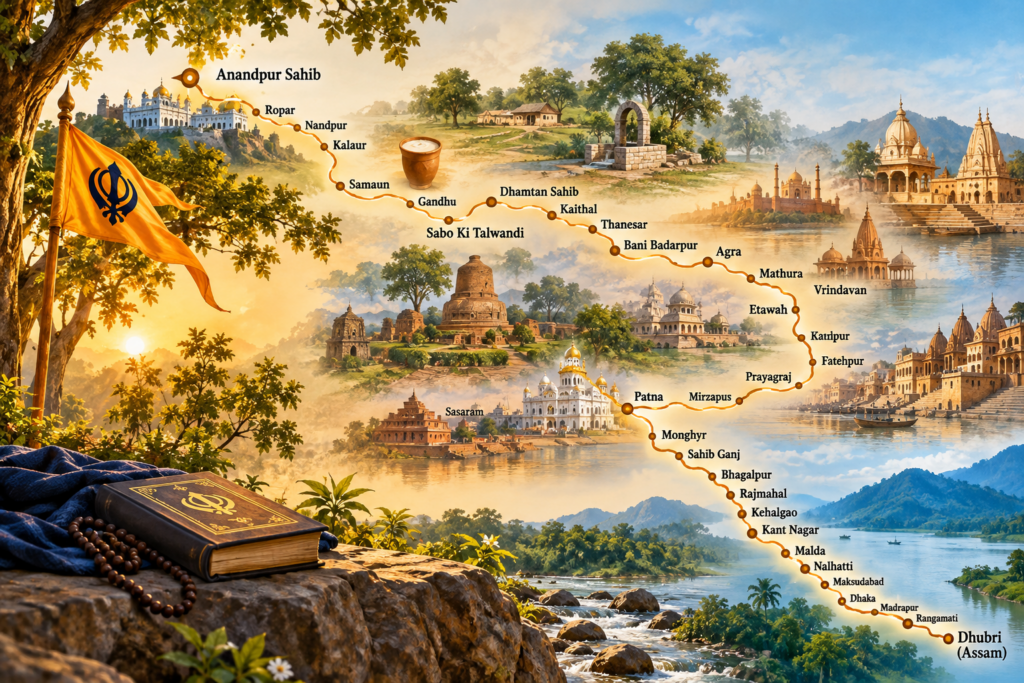
Sri Guru Tegh Bahadur Ji did not stay for a long time at Chak Nanaki. Guru Sahib appointed his devotees to supervise the construction of this new town and left for eastern travels with some devotees and family. From Sri Anandpur Sahib, while preaching the Sikh religion in the villages of Ropar, Nandpur, Kalaur, Dadu Majra, Ugana, Nao Lakha, Tehilpura, Sekhe, Pharwahi, Dhilwan etc., Guru Sahib reached near the village of Samaun. A zamindar served the Sangat with lassi (buttermilk) and Guru Sahib gave a boon that there will always be milk available in your house. While passing through different villages, Guru Sahib arrived at Gandhu village and visited a Sikh named Bhai Muglu at his last moments of his life. Bhai Muglu had prayed for a glimpse of the sixth Guru at his last time. Guru Sahib promised to meet him later. He got delighted to see Sri Guru Tegh Bahadur Sahib. Guru Sahib stayed at Sabo Ki Talwandi while preaching through various villages. From here, Guru Sahib moved to Dhamtan Sahib (presently exists in Haryana state). Guru Sahib reached Bani Badarpur via Kaithal, Barne, Thanesar. Here, Guru Sahib gave a bag full of money to a landlord and instructed him to plant a garden and got a well dug for comfort of the people. From Bani Badarpur Guru Sahib camped outside the village of Sudhail. Next to this, Guru Sahib entered Agra via Kade Manakpur, Mathura, Vrindavan.
At this place, Guru Sahib stayed in the house of a pious old lady, named Mai Jassi in Mai Than Mohalla of the city. A Gurdwara named Mai Than is situated here. From here, Guru Sahib moved to Etawah. Having visited Etawah, Guru Sahib passed through the towns such as Kanpur, Fatehpur, Prayagraj, Mirzapur, Benaras. Guru Sahib stayed at Benaras for some days. Then Guru Sahib visited Sasaram, Bodh Gaya, Raigarh etc. and reached Patna. After staying some time at Patna, Guru Sahib left his family at Patna and moved towards the travel of Assam. During this travel, Guru Sahib received the news about the birth of his son Sri (Guru) Gobind Rai. After the birth of Sri (Guru) Gobind Rai Ji, Sri Guru Tegh Bahadur Ji sent blessings to the Sangat of Patna through a Hukamnama.
Guru Sahib moved towards Band, Monghyr, Sahib Ganj, Bhagalpur, Rajmahal, Kehalgao, Kant Nagar. From Kant Nagar, he visited Malda, Nalhatti, Maksudabad, Dhaka, Madrapur, Rangamati and arrived Dhubri (Assam). When Guru Sahib was travelling towards east, Raja Ram Singh (son of Raja Mirza Jai Singh) was sent by Aurangzeb to lead a campaign against Ahom ruler, Chakradhvaj. Guru Sahib played the role of a peace-maker between the warring forces.
After the rainy season, Guru Sahib decided to return back to Punjab. Guru Sahib desired to reach Punjab very soon due to a change in the socio-religious policy of Aurangzeb who adopted a totally uncompromising attitude towards the non-Muslims. Aurangzeb adopted policy of forcible conversions of non-Muslims to Islam.
Travel to Malwa and Bangar
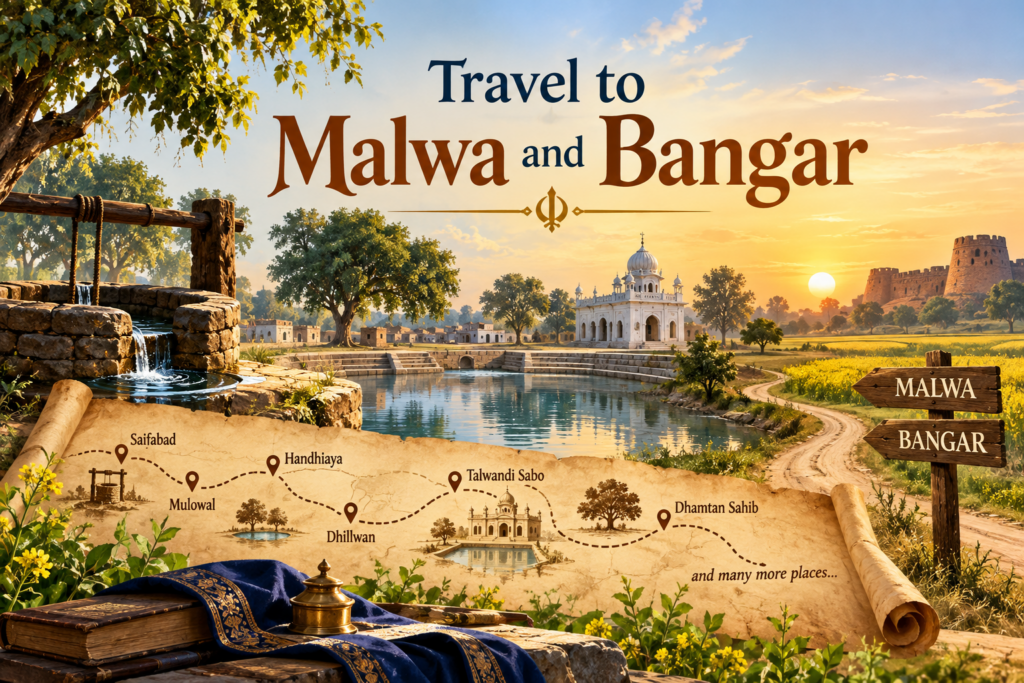
Malwa preaching travel was the last preaching tour of Sri Guru Tegh Bahadur Ji. The details of this travel are based on Malwa Desh Rattan Di Sakhi Pothi According to Malwa Desh Rattan Di Sakhi Pothi, Guru Sahib stayed with Sharaf Din (Saif Khan) at Saifabad (Bahadurgarh) during his journey to Malwa. Saif Khan was very happy after a holy visit of Guru Sahib. Next to this, Guru Sahib rested for nine days at village Mulowal and sweetened the water of the brackish well. Guru Sahib’s next stop was at Handhiaya. Here Guru Sahib advised the Sangat to take bath in a small pond to get rid of their sorrows. The Sangat of Dhillwan welcomed Guru Sahib with great honour. Guru Sahib stayed here for a few months. After this, Guru Sahib camped at Dikhi, Myser Khan, Alisher, Bhupali. Chaudhari Jagraj was instructed by Guru Sahib to settle a village on Theh (mound or heap of ruins) where Joga (Mansa) village got established. After this, a devotee named Singha served Guru Sahib at Khiva village. At the village of Samaun, Guru Sahib met the Sangat of Kabul. A zamindar presented a meal for Guru Sahib.
At the village Bhikhi, a zamindar Des Raj blessed with Sikhi by Guru Sahib. In addition, Guru Sahib visited at Khayale and Maur Kalan villages. The next place of Guru Sahib’s visit was Talwandi Sabo. Guru Sahib promised that a big shrine would be built here. Guru Ji marked a takk (inaugurated the construction) of Gurusar Sarovar. Later, Guru Sahib stayed at Bathinda for nine days. After having a visit at Sulisar, Guru Sahib stayed at Bara for four months of the rainy season. Next to this, Guru Sahib moved to Bachhoana, Gobindpura, Gaga, Gurni (Gurne Kalan), Makrorh for some time. At Makrorh, Jatt clan of Gaga regretted for their mistakes and Guru Sahib forgave them. Guru Sahib’s next stoppage was at Dhamtan Sahib (Haryana) in Bangar. Guru Sahib stayed here for a long time. Bhai Daggo served Guru Sahib with milk. After this, Guru Sahib moved on to Khanaur and Bahirjakh (Bahirjach). A Sikh from Bahirjakh honoured Guru Sahib. Guru Sahib advised him to meditate on the Name of the Almighty. Moreover, Guru Sahib visited Kaithal, Barne and Karan Khede. While preaching the Sikh religion, Guru Sahib solved the problems of people, got many wells dug and taught the people to sing the praises of Akal Purakh. After the completion of this travel, Guru Sahib returned back to his home town Chak Nanaki.
Martyrdom of Sri Guru Tegh Bahadur Ji
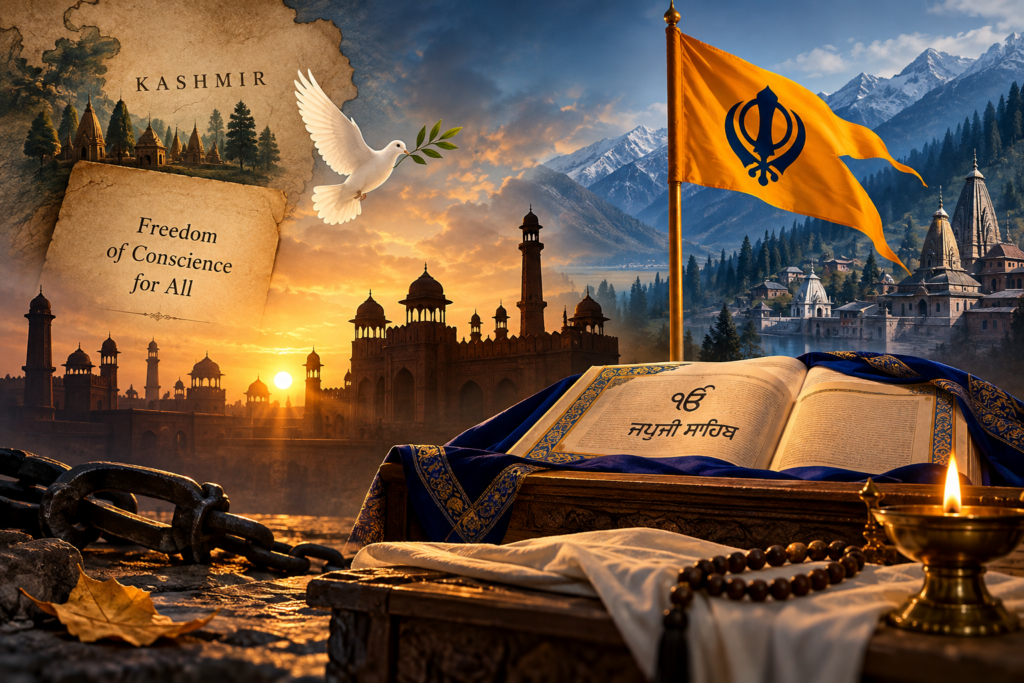
Sri Guru Tegh Bahadur Ji is revered as a saviour who embraced martyrdom to protect one’s religious rights. At the time of Sri Guru Tegh Bahadur Ji, the Mughal Emperor Aurangzeb wanted to establish only Darul-Islam (Pure Islamic state) in India. The forcible conversions were being carried out. Many temples were demolished on the orders of Aurangzeb. In this situation, the Sikhs also suffered along with the Hindus. As Khafi Khan mentions, “Aurangzeb ordered the temples of the Sikhs to be destroyed and the Guru’s agents (Masands) for collecting the tithe and presents of the faithful to be expelled from the cities. ” There was also discrimination in the policy of taxation against the non-Muslims.
Due to a large number of educated Brahmins living in Kashmir, it was chosen first to convert to Islam. The policy was that with the conversion of Kashmiri Brahmins to Islam, the rest of the Hindus would also follow them. Iftikhar Khan, the Governor of Kashmir was implementing Aurangzeb’s policy of making Kashmir the Muslim land. While addressing the Kashmiri Pandits, he announced the order of emperor to convert the Kashmiri Pandits to Islam. The Pandits asked for six months’ time and deliberated on it. Finally, they decided to take the help of Sri Guru Tegh Bahadur Ji. Pandit Kirpa Ram Datt (son of Aru Ram, a resident of Matan) who spent some time at Chak Nanaki (Sri Anandpur Sahib) was known to Sri Guru Tegh Bahadur Ji.
On May 25, 1675 a delegation of Kashmiri Brahmins led by Pandit Kirpa Ram Datt, arrived at Chak Nanaki in the asylum of Sri Guru Tegh Bahadur Ji. According to their statement, the ruler of Kashmir was forcibly converting Brahmins to Islam. It is mentioned in Gurbilas Patshahi Dasvin that the Brahmins of Kashmir narrated their whole story to Sri Guru Tegh Bahadur Ji with heavy heart. “According to a tradition, after hearing the plea of Kashmiri Pandits, Sri Guru Tegh Bahadur Ji’s mind dipped into deep thoughts. Sri (Guru) Gobind Rai asked the reason behind the seriousness of his father. Sri Guru Tegh Bahadur Ji told about the danger to the religion of Kashmiri Pandits and stated that only martyrdom of some great person may save their religion. Hearing this, (Guru) Gobind Rai replied, “who can be greater than you”? Guru Sahib was much pleased with his son’s answer and told the Kashmiri Pandits, “Give a message to Aurangzeb that if Sri Guru Tegh Bahadur becomes a Muslim, they will also convert to Islam”.” Rattan Singh Bhangu also mentioned this incident in Panth Parkash.
As Sri Guru Tegh Bahadur Ji had instructed the Brahmins, they also stated that if they convert Sri Guru Tegh Bahadur Ji into Islam, then they too will adopt the same.
It is considered that the proposal of Guru Sahib was conveyed by the Brahmins to Aurangzeb through the province of Lahore who was at Hasan Abdal. Guru Sahib proceeded from Chak Nanaki to Delhi with his Sikhs Bhai Mati Das Ji, Bhai Sati Das Ji and Bhai Dayala Ji. On arriving at Malakpur Rangharan near Ropar, Guru Sahib was arrested by Mirza Noor Muhammad Khan, the Kotwal of Ropar and sent to Sirhind.
Some sources are agree with a view that Sri Guru Tegh Bahadur Ji was detained at Agra. Guru Sahib and the Sikhs were imprisoned in Bassi Pathana for more than three months by Faujdar Dilawar Khan of Sirhind. Later on, Guru Sahib was locked in an iron cage and brought to Delhi. According to Aurangzeb’s instructions, Guru Sahib was placed in Kotwali and tortured for eight days. The state placed three conditions before Guru Sahib:
1) Show miracles
2) Accept Islam
3) Be ready to die.
Guru Sahib did not accept the first two conditions and agreed to accept the third condition. Many tactics were used to apply the first two conditions and Guru Sahib was subjected to inhuman torture. But Guru Sahib remained firm on his decision.
Three Sikhs of Guru Sahib:
Bhai Mati Das Ji,
Bhai Sati Das li and
Bhai Dyala Ji
were brought in front of Guru Sahib. In order to demoralize Guru Sahib, the Qazi issued an order (fatwa) to martyr these three in front of Guru Sahib,
Bhai Mati Das Ji was tied to two poles and sawn alive. Bhai Mati Das Ji started reciting Japu Ji Sahib when the saw placed on his head. As long as the saw cut on the body, the recitation of Japu Ji Sahib also continued.
Bhai Sati Das Ji was wrapped up in cotton wool. After this, he was set on fire and roasted alive.
Bhai Dyala Ji was boiled alive in a cauldron of hot water. All the three Gursikhs did not accept Islam and attained martyrdom. Sri Guru Tegh Bahadur Ji was asked to show miracles or accept Islam but Guru Sahib refused to do so. After this, an order was issued to behead Sri Guru Tegh Bahadur Ji.
Guru Sahib recited Japu Ji Sahib. On Maghar Sudi Panchami Samvat 1732 (November 11, 1675), Guru Sahib was beheaded and thus embraced martyrdom at Chandni Chowk in Delhi. At present, Gurdwara Sis Ganj Sahib at Chandni Chowk Delhi stands here. Guru Sahib gave martyrdom to protect the religious rights of others but remained firm in his own religion. Guru Sahib resisted Aurangzeb’s oppression with patience. The martyrdom of Sri Guru Tegh Bahadur Ji is a testimony of accepting martyrdom against religious tyranny. The history of world does not mention that any Prophet who may have given martyrdom for other’s religion like Sri Guru Tegh Bahadur Ji. Bachittar Natak mentions that Guru Sahib attained martyrdom for the sake of religion.
Guru Sahib got martyred while confronting the oppression and injustice of the contemporary government. Bachittar Natak mentions about the unparalleled martyrdom of Sri Guru Tegh Bahadur Ji. Poet Sainapat also gives testimony in Sri Gur Sobha about the remarkable contribution of Sri Guru Tegh Bahadur Ji.
After Guru Sahib’s martyrdom, his Sacred Head and Body were lying in Delhi’s Chandni Chowk. Bhai Jaita Ji respectfully picked up the Sacred Head of Guru Sahib and departed from Delhi. Meanwhile, his first stay was at Baghpat, second at Karnal, third at Anaj Mandi Ambala, fourth at Nabha Sahib near Chandigarh and fifth at Sri Kiratpur Sahib. From Sri Kiratpur Sahib, Sri Guru Gobind Singh Ji brought the Sacred Head of Guru Sahib with great reverence to Sri Anandpur Sahib and cremated there. Now, Gurdwara Sis Ganj Sahib stands here. On leaving Sri Anandpur Sahib, Sri Guru Gobind Singh Ji handed over the service of this Gurdwara Sahib to Baba Gurbakhsh Das Udasi.Bhai Lakhi Shah Ji, with the help of his sons, brought the body of Guru Sahib from Chandni Chowk to his house that Bhai Jaita Ji carried the Sacred Head of Guru Sahib the same day in the evening. Panth Prakash also mentions and Bhai Lakhi Shah Ji cremated the Body of Sri Guru Tegh Bahadur Ji. Where Guru Sahib’s Body was cremated, Gurdwara Rakab Ganj Sahib at Delhi is located there.
Impact of the Martyrdom of Sri Guru Tegh Bahadur Ji
The martyrdom of Guru Sahib took a huge transformation in the activities of the Sikh Panth. Sri Guru Gobind Singh Ji revealed the Khalsa on Baisakhi of 1699 СЕ. After the initiation ceremony, (Khande Di Pahul) discrimination of high and low caste was abolished. Dr. Taran Singh writes:
Due to this martyrdom, the conscience of the world was awakened. The Khalsa was revealed. There were royal orders that non-Muslims were not allowed to carry weapons and wear military uniforms. The Khalsa kept shastras, adorned Kirpan, increased horse riding and hunting. The Khalsa built forts and fought battles. The conclusion was that fear of the tyrannical government ended and began to leave the minds of Indians. Prof. Puran Singh describes in his work The Ten Masters, “A great dust storm swept that day over Delhi, and the sky was blood-red. This storm of dust carried off the Empire of Aurangzeb as if it were a dead leaf lying on the road. The Master yet lived.”
The impact of the martyrdom of Sri Guru Tegh Bahadur Ji depicted by Indu Bhushan Banerjee as “the Guru’s execution undoubtedly strengthened the resistance against the religious policy of Aurangzeb and at the same time, prepared the way for the final stage in the evolution of Sikhism.” Guru Sahib’s martyrdom inspires the human beings to rise above religious fanaticism. It teaches the people to fight against all forms of oppression. Sri Guru Tegh Bahadur Ji’s martyrdom was against the interference of the State towards one’s faith. This martyrdom filled the minds of Sikhs with self-confidence, fearlessness and gave a spirit to live in Chardi Kala. Guru Sahib’s martyrdom teaches to have faith in the One Supreme Being, to be firm in one’s religion, to rise above attachment and illusion, not to accept anyone’s tyranny and injustice.
Bani of Sri Guru Tegh Bahadur Ji
There are 59 shabdas and 57 salokas of Sri Guru Tegh Bahadur Ji incorporated in Sri Guru Granth Sahib Ji. His 57 salokas are recorded under the title Saloka Mahala 9 and shabdas are incorporated in 15 ragas. These salokas form the concluding part of Sri Guru Granth Sahib Ji inserted between 1426 to 1429 pages. 59 shabdas of Sri Guru Tegh Bahadur Sahib Ji are divided into 15 ragas as follows:
Gauri09, Asa01, Devgandhari03 Bihagara01, Sorath12, Dhanasari04, Jaitsari03, Todi01, Tilang03, Bilaval03, Ramkali03, Maru03, Basant05, Sarang04, Jaijawanti04 Total59
The Bani of Sri Guru Tegh Bahadur Ji focuses on One Supreme Reality. The Almighty is described as Omnipresent, Omniscient, Omnipotent, Most Gracious etc. Besides this, various themes such as: significance of human life, self-realization, liberation (Jivan Mukti), Amar Pad etc. are discussed. Sri Guru Tegh Bahadur Ji conveys the message in a metaphorical language. The main themes of Sri Guru Tegh Bahadur Ji’s Bani are as follows:
Akal Purakh
Sikh religion believes in existence of the One Supreme Being (Akal Purakh). He is the only permanent and eternal existence. Sri Guru Tegh Bahadur Ji addressed Akal Purakh with innumerable attributive names as Gobind, Ram, Brahm, Parbrahm, Hari, Prabh, Bhagwan, Narayan, Swami, Raghunath, Murari, Thakur etc. Guru Sahib’s Bani gives a message that the Almighty is Omnipresent and lives in our self. There is no need to go to forests to unite with Him. The Bani of Sri Guru Tegh Bahadur Ji illustrates that whole of the world wanders for begging, but the Almighty is the Giver of all. Akal Purakh is so powerful that He can transform the king into a beggar and a beggar into the king. He can fulfill the empty and empties the full.
Creation of the Universe
All the universe is the creation of One Supreme Being who Himself creates, sustains and destroys all. Sri Guru Tegh Bahadur Ji explains that all the creation has been created by the Almighty Himself. Nothing is immortal in this universe except the One Supreme Being. Everything is perishable like ‘the shadow of a cloud’. Guru Sahib uses the metaphor of ‘wall of the sand ‘ and ‘a dream’ to describe the uncertainty of this world.
Maya
According to Indian philosophy, Maya is interpreted variously as a veil or a curtain concealing reality; the phenomenon world; the grand illusion etc. In Sikh religion, Maya refers to worldly illusion that leads the senses to worldly attachment and dissatisfaction. Maya makes an obstacle to the path of self-realization. In Gurbani, Maya is also described as wealth. Gurbani advises the human beings to escape from the impact of Maya. Maya come into existence at the Will of Supreme Reality and disappears after His ordinance. In the Bani of Sri Guru Tegh Bahadur Ji, there are many shabdas give description about Maya. Guru Ji illustrates that Akal Purakh Himself expands his Maya and beholds it but remains detached from it. Maya is also mentioned as a slave of the Almighty. Human beings wander day and night for the sake of Maya (wealth). The Almighty resides in those persons who renounce Maya.
Human Life
Human life is very significant and precious. Man is the central figure in the whole universe. Human Beings are supreme than other innumerable species of this universe. The Bani of Sri Guru Tegh Bahadur Ji describes that human life is invaluable attained after the cycle of transmigration. All the humans have been advised to sing the praises of One Supreme Reality. One may merge with the Almighty by remembering His Name. Sri Guru Tegh Bahadur Ji focuses upon the goal of this priceless human life i.e. remembrance of Supreme Reality, Mind (Man)Mind (Man) has very central place in our human body but no physical existence. In Sri Guru Granth Sahib Ji, mind is described as the embodiment of the Divine Jot. Self-centered person (Manmukh) works according to his own mind and chases after worldly desires. Human mind indulges in various evils which make an obstacle to the path of self-realization. Conquering of mind means one has conquered the world. The Bani of Sri Guru Tegh Bahadur Ji deals with the evils of this mind as well as addresses repeatedly this mind to love the Almighty, to hear and listen His praises.
Nam Simran (Recitation of Nam)
Remembering the Name of Akal Purakh occupies a most significant place in Sikh religion. It is a path that leads to the realization of the One Supreme Being. Sri Guru Tegh Bahadur Ji emphasizes that human beings suffer by pain without the Name of Supreme Being.” The Name of Akal Purakh is the dispeller of all the sorrows, evil-thoughts. One may attain the state of Nirbana by meditating on His Name.
Jivan Mukti (Liberation)
In the view of Gurbani, Jivan Mukti is the highest goal of human life. It means freedom from self-bondage and transmigration. One may attain liberation while performing his household duties. There is no need to renunciate this world to merge with Supreme reality. Jivan Mukti leads to the path of self-realization. Sri Guru Tegh Bahadur Ji illustrates that one who is beyond the impact of praise and slander, pleasure or pain, who treats gold and iron, a friend and enemy alike, such person is considered liberated. A person who sings the praises of one Akal Purakh, abandons pride and attachment is called Jivan Mukt as per the Bani of Sri Guru Tegh Bahadur Ji. Furthermore, Guru Sahib has used Nirban, Nirbana, Nirbhai etc. words for the state of liberation. The Bani of Sri Guru Tegh Bahadur Ji advises human beings to adopt the path of self-realization, that transcends to the ultimate goal.
ਸੋਰਠਿ ਮਹਲਾ ੯ ॥
ਮਨ ਰੇ ਕਉਨੁ ਕੁਮਤਿ ਤੈ ਲੀਨੀ ॥
ਪਰ ਦਾਰਾ ਨਿੰਦਿਆ ਰਸ ਰਚਿਓ ਰਾਮ ਭਗਤਿ ਨਹਿ ਕੀਨੀ॥੧॥ਰਹਾਉ॥
ਮੁਕਤਿ ਪੰਥੁ ਜਾਨਿਓ ਤੈ ਨਾਹਨਿ ਧਨ ਜੋਰਨ ਕਉ ਧਾਇਆ॥
ਅੰਤਿ ਸੰਗ ਕਾਹੂ ਨਹੀ ਦੀਨਾ ਬਿਰਥਾ ਆਪੁ ਬੰਧਾਇਆ॥੧॥
ਨਾ ਹਰਿ ਭਜਿਓ ਨ ਗੁਰ ਜਨੁ ਸੇਵਿਓ ਨਹ ਉਪਜਿਓ ਕਛੁ ਗਿਆਨਾ॥
ਘਟ ਹੀ ਮਾਹਿ ਨਿਰੰਜਨੁ ਤੇਰੈ ਤੈ ਖੋਜਤ ਉਦਿਆਨਾ॥੨॥
ਬਹੁਤੁ ਜਨਮ ਭਰਮਤ ਤੈ ਹਾਰਿਓ ਅਸਥਿਰ ਮਤਿ ਨਹੀ ਪਾਈ॥
ਮਾਨਸ ਦੇਹ ਪਾਇ ਪਦ ਹਰਿ ਭਜੁ ਨਾਨਕ ਬਾਤ ਬਤਾਈ॥੩॥੩॥
ਸ੍ਰੀ ਗੁਰੂ ਗ੍ਰੰਥ ਸਾਹਿਬ, ੬੩੧-੩੨