
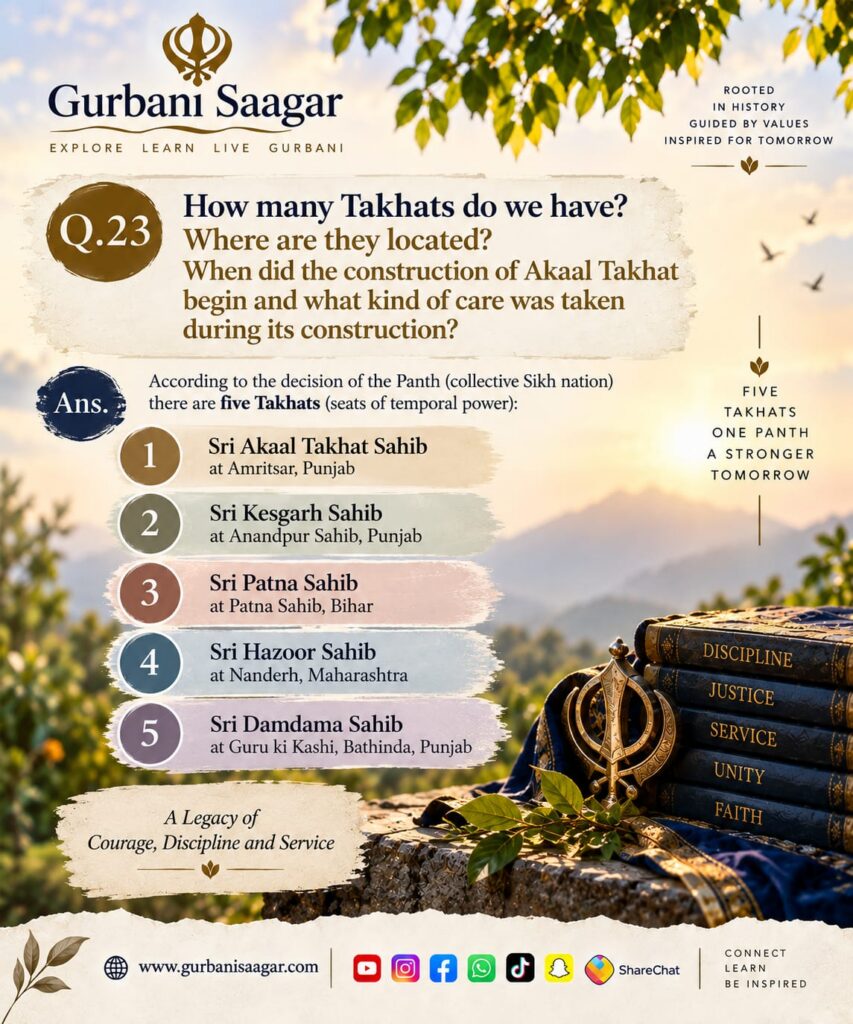
Ans. According to the decision of the “Panth” (collective Sikh nation) there are five Takhats (seats of temporal power)*:
- Sri Akaal Takhat Sahib, at Amritsar, Punjab;
- Sri Kesgarh Sahib, at Anand Pur Sahib, Punjab;
- Sri Patna Sahib, at Patna Sahib, Bihar;
- Sri Hazoor Sahib, at Nanderh, Maharashtra;
- Sri Damdama Sahib, at Guru ki Kashi, Bathinda, Punjab.
The construction of Akaal Takhat was started on July 9, 1609. Gur Bilas Patshahi Chhevin gives the following description:
In the month of Asarh (Bikrami calendar), on Panchmi (fifth Lunar day) Guru Har Gobind started a great project. Along with Bhai Gurdas and Baba Buddha Ji, he began the construction of the takhat. After Ardaas (supplication) and distribution of Prasaad (blessed sacramental pudding) the foundation stone was laid by the Guru himself, making it (Amritsar) an eternal city.
Special care was taken that during its construction no paid mason, carpenter or labour was allowed to help in this project. Construction of the entire building was carried out by the Guru himself with the help of Bhai Gurdas and Baba Buddha (and devoted Sikhs). The dome of Akaal Takhat is upright while that of the Golden temple is relatively flat. The former is symbolic of valour while the latter signifies humility.
According to Sikh Rehit Maryada (the Sikh code of conduct) the highest office for appeals for Sikh affairs is Akaal Takhat. Every entity needs a goad to control it and keep discipline (e.g. an elephant is kept under control by a goad). Similarly, Akaal Takhat’s respect and fear acts as a goad over all the Sikh Nation. One must remember that the tighter the discipline and control over the Panth, the stronger will it be to stand firmly on its feet.
To question as to who is the person issuing commandments from Akaal Takhat is self-directedness and egoistic. The worldly rulers have their courts of justice to administer law and order and it does not matter who the judge is. Because it is the ruler in whose name the justice is administered. Similarly, the Jathedar of Akaal Takhat administers justice in the name of the Guru. On the stamp of Akaal Takhat the words embossed are: “Akaal Sahaae Khalsa Ji” (may God help the Khalsa).
It is written in Prachin Panth Prakash” that when the Sikhs used to come to Amritsar on Diwali and/or Baisakhi, they would sit first in the Hari Mandir, absorbed in the Divine knowledge, concentrate on Guru’s word. Then they would sit at Akaal Takhat and pass the Gurmattas. They would decide on punishment to the enemies and help to the needy. The following used to be the Ardaas (supplication) at Akaal Takhat twice a day (morning and evening): May God bless the whole world and may the Panth stay ever in God’s favour.
- The appointment of the Jathedar of Akaal Takhat by the president of Shromini Gurdwara Parbandhak Committee (SGPC), which is an organization under the control of the Government of India, has resulted in objections by many Sikh organizations. This has recently happened because of indiscriminate appointments and dismissals of several Jathedars whose appointments were because of political reasons rather than their qualifications.
- Historically there were four Takhats, the Akaal Takhat, Takhat Sri Patna Sahib, Sri Kes Garh Sahib (Anandpur) and Takhat Sri Hazoor Sahib (Nanderh). The fifth Takhat, Damdama Sahib was established in the sixties.