
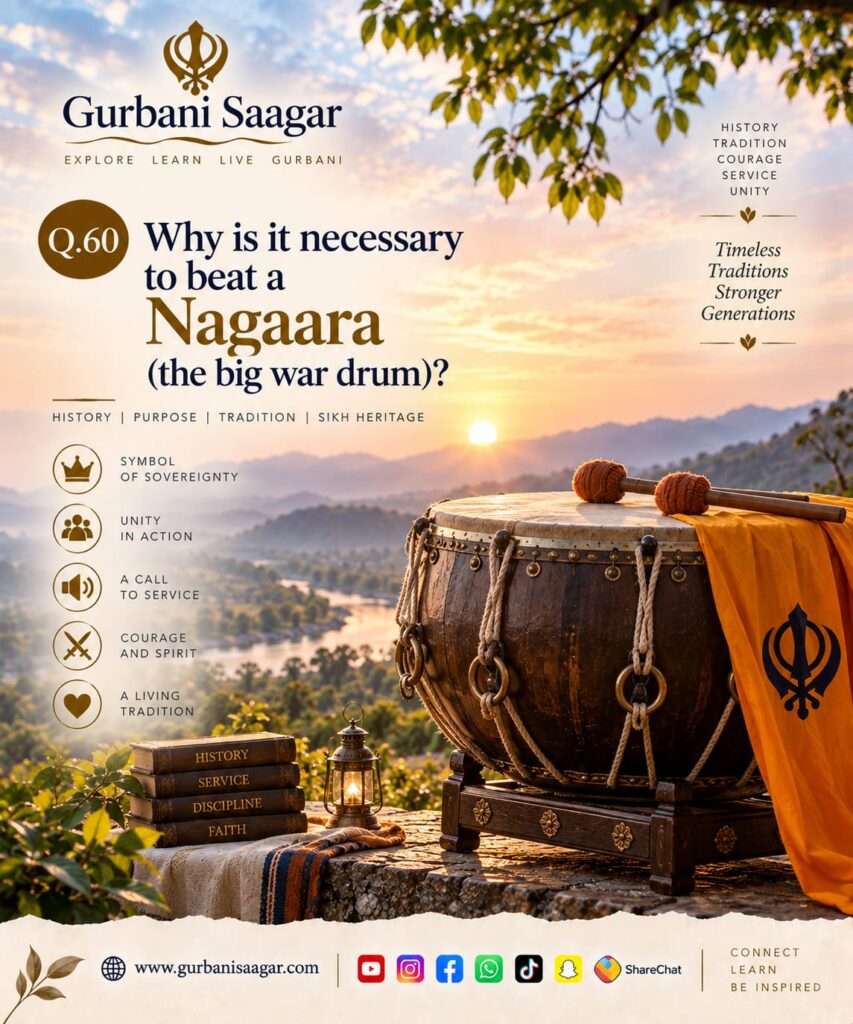
Ans. In old days beating of a Nagaara symbolized the sovereignty of a ruler.
At the time of assuming the governorship of Kaabul, prince Muazzim (later on emperor Bahadur Shah) ordered the beating of Nagaara. When his father, emperor Aurangzeb heard this news, he wrote to Muazzim, “When Allah bestows upon you the crown of an emperor, you can then beat the Nagaara; until then, however, you should be contented on beating four smaller drums”.
The same emperor Aurangzeb had written to the governor of Sirhind that he should take strong (military) action against Guru Gobind Singh if he does not stop sitting on a throne in his congregation and beating the Nagaara.
The tradition of beating of Nagaara was started during the time of Guru Har Gobind. Whenever the Guru moved from one place to another, Nagaara was beaten continuously.When Guru Har Gobind appointed Bhai Roopa to preach Sikhism in distant lands, he gave him the flag and a Nagaara. This meant that he (Bhai Roopa) should feel free (like a sovereign) and preach.
Even today when early in the morning the procession of Guru Granth Sahib starts from Akaal Takhat towards the Golden Temple for the opening ceremony, Nagaara is constantly beaten.
The seventh Master, Guru Hari Rae, had given orders to beat the Nagaara at the time of starting Langar (common kitchen) so that everyone should know that the serving of food has started. Outside the court of the eighth Master, Guru Hari Krishan, a Nagaara was kept and beaten at appropriate times. In Anandpur Sahib (at the time of the tenth Master) when Ranjit Nagaara was beaten and it resounded the Shivalik hills, its reverberations would instill enthusiasm and vigour in the hearts of the Sikhs while the hill Rajas would tremble in fear. This Ranjit Nagaara was made at Anand Pur in 1684.
Maharaja Ranjit Singh used to say, ” do not call me Ranjit Singh, I am the Ranjit Nagaara (of Guru Gobind Singh), trying to send aloud the message of the Guru to the populace”.
Within a Gurdwara a Nagaara is a must* and it should be beaten each morning at the time of opening of Guru Granth Sahib. This would openly declare to everyone that this is the roval court of the true emperor. The tradition of keeping a Nagaara in every Gurdwara is still in vogue. Even the historic Gurdwaras still hold on to this tradition.