
Ans. For ages, the gods, human beings and sages had been in search of the Amrit, says Guru Amar Das:
“ਸੁਰਿ ਨਰ ਮੁਨਿ ਜਨ ਅੰਮ੍ਰਿਤ ਖੋਜਦੇ”
(SGGS, P. 918)
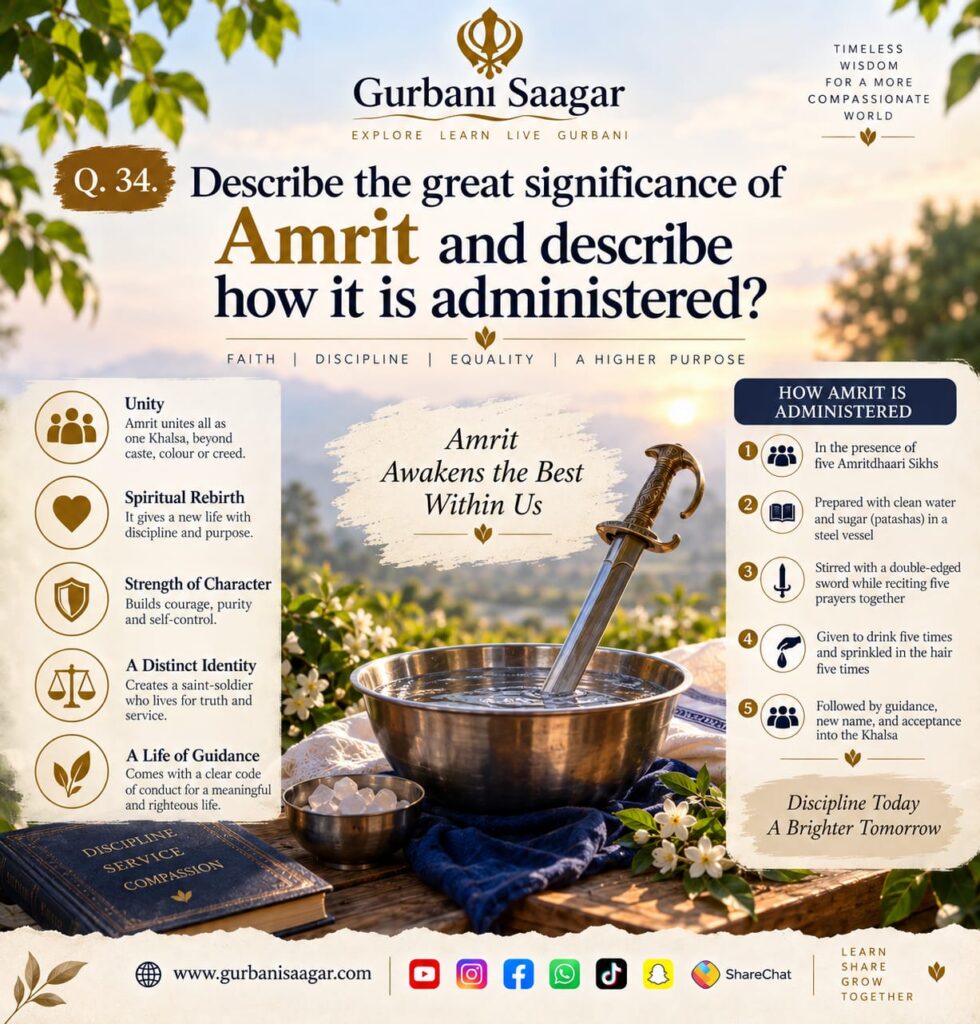
The Sikh is fortunate that the Guru not only administered the Amrit to him but also told him the procedure to prepare it.
Furthermore, the Guru not only enjoined (the Sikh) to take the Amrit from five beloved ones but he himself took it from them, thus emphasizing its necessity.
Guru Gobind Singh was a perfect divine being, master of all faculties. But when he himself, kneeling on one knee (in the posture of a warrior), took Amrit (from the five beloved ones), that should have put an end to today’s discussion regarding the need or importance of (taking) Amrit.
The Amrit for which the divine emperor Guru Gobind Singh himself expressed such keen desire, leaves very little for insignificant mortals like us to question its importance?
In Gur Bilas Patshahi 10 of Bhai Kesar Singh it is stated that Guru Gobind Singh got down from his throne and with folded hands requested the five beloved ones to bestow the divine gift of Amrit upon him and thereby include him also in the Khalsa brotherhood.
From that moment on there was to be no difference between Jat and non-Jat, high and low (in social status), and teacher and disciple. On hearing these words of the tenth Master all became quiet but one of the beloved ones asked,
“O true king, how could we do that?”
The Guru replied, “Be alert and administer the Amrit to me just as you have been administered by your Guru”.
Never say, “Amrit was administered by such and such group or such and such person”. Waheguru (God) Himself resides in the five beloved ones. The directive to the Sikh is:
The true Guru has administered the Amrit. I do not know anyone else
ਅੰਮ੍ਰਿਤੁ ਪੀਆ ਸਤਿਗੁਰਿ ਦੀਆ॥
ਅਵਰੁ ਨ ਜਾਣਾ ਦੂਆ ਤੀਆ॥
(SGGS, P. 1033)
The procedure for administering Amrit is as follows:
A relatively quiet place should be selected where everyone cannot walk by. In the presence of (at least) six Amritdhaari Sikhs (those who have been initiated to Khalsa brotherhood by going through Amrit ceremony), Guru Granth Sahib should be installed. One of these six Sikhs should sit behind Guru Granth Sahib. The remaining five are to administer brotherhood also. All should have washed their hair. None of them should be handicapped or be inflicted with any punishment for violating the Khalsa code. Every male or female, irrespective of caste, race, colour or creed has a right to administration of Amrit. It is, however, necessary that he/she is capable of making such a conscious decision to the Amrit.
These may include female members of Khalsabat disease. None of them should have undergone any punishment for violating the Khalsa code.
All the recipients of Amrit should also have washed their hair and be wearing the five K’s (kesh, kangha, karha, kachhehra and kirpan with sash). They should not have upon them any symbol of any other religion. It is necessary that those who had once taken Amrit but violated by committing any cardinal sins and want to take it again be separated from the group that is taking Amrit for the first time. The beloved ones (officiants) should pronounce the punishments (tankhaah) levied on them in the congregation (if present).
Those aspiring to take Amrit should first be told the principles and tenets of Sikhism. Then they should be asked if they are accepting Sikhism of their own free will. Upon receiving the answer in affirmative one of the five beloved ones should lead in a supplication for preparation of Amrit. At the conclusion of the supplication the commandment from Guru Granth Sahib should be read. Now the five should approach the vessel (bata) to be used for preparation of Amrit. This vessel should be made of steel and be placed on a stool or a clean seat.
Clean water and sugar drops (patashas) should be added to the vessel and the five should sit around it in a warrior posture (with right knee on the ground while the weight of the whole body on the upper portion of right foot and left knee pointing upwards).
The following five prayers should then be recited at the same time stirring the sugar solution in the vessel with a double-edged sword (khanda):
1. Japu Ji.
2. Jaap Sahib.
3. Ten (sudha) sawaiyye.-).
4. Bainti Chaupai (hamri karo haath de rachha-
5. Anand Sahib (six stanzas the first five and the last one).
The person reciting the prayer should have his/her left hand on the vessel and stir the Amrit with the double-edged sword with the right hand.
All the remaining beloved ones should have both their hands on the vessel. While reciting the prayer the minds should be focused on the prayer and eyes on Amrit.
Upon completion of the prayers another supplication (Ardaas) should be offered. Care should be taken that no one joins the group of original aspirants of Amrit in the middle of the ceremony. Following the supplication every aspirant be made to sit in the warrior posture, placing right hand on his/her left hand.One of the five beloved ones should then give five palm-full of Amrit to drink to each aspirant. On administering each palm-full the beloved one utters (loudly),
“Waheguru Ji ka Khalsa, Waheguru Ji ki Fateh”, the Amrit receiver then repeats (loudly), “Waheguru Ji ka Khalsa, Waheguru Ji ki Fateh”.
Then Amrit is sprinkled five times in the recipient’s hair and each time the same routine of “Waheguru Ji ka Khalsa, Waheguru Ji ki Fateh” is to be repeated.
Whatever Amrit is left is to be consumed by the recipients from the same vessel.
Now the five beloved ones together pronounce, “Waheguru Ji ka Khalsa, Waheguru Ji ki Fateh” and then recite the “Mool Mantra” (Ik Oankaar, Satt Naam, Karta Purakh, Nirbhau, Nirvair, Akaal Moorat, Ajooni, Saibhang, Gur Prasaad) and have it memorized by the recipients. One of the five then narrates the Sikh Rehit (Code of ethics) and pronounces:
“The recipients are now reborn and have joined the Khalsa brotherhood. Their spiritual father is Guru Gobind Singh and mother Mata Sahib Kaur. Their (spiritual) birthplace is Keshgarh Sahib and they are natives of Anand Pur Sahib.
Thus, being the sons/daughters of the same (spiritual) parents they are all siblings. They have now become pure persons having renounced their prior race, caste, religion, tribe etc. They are not supposed to worship any god, goddess, prophet or avtaar except Almighty God and not to consider anyone except the ten Gurus and their divine word (Guru Granth Sahib) as the emancipator.
It is necessary to learn Gurmukhi (if they already do not know) and recite the prescribed prayers daily”.
“In the morning recite Japu Ji, Jaap Sahib and Sawaiyye; Either read yourself or listen when someone else is reading from in the evening recite Rehraas and before going to bed recite Sohila Guru Granth Sahib. Stay away from the company of apostates and those who smoke. Always stay ready for the service of Gurdwaras and the Panth. Give tithe (one tenth of your honest earnings) in charities and carry out all chores according to the directions of the Guru (Sikh code of conduct). Stay united as a member of the Khalsa brotherhood. If any of the Sikh tenets has been (advertently or inadvertently) violated, present yourself to the Khalsa congregation, request for and accept the punishment and be careful in future.The following deserve punishment:
Those who keep company of schismatic sects like Meenas, Masands, Dhirmalyas, Ram Raiyas and other enemies of the Panth; who smoke tobacco, commit infanticide (of daughters), eat out of the same plate as a non-Khalsa, dye their hair, accept or give dowry in the marriage of their sons and daughters, do any intoxicants (marijuana, opium, cocaine, heroin, alcohol etc.), perform any rites that are contradictory to the Guru’s directions, violate any Khalsa code.
After this sermon a supplication is said and commandment (vaak) from Guru Granth Sahib is read. If any one of the recipients had his/her name chosen in a way other than the Sikh procedure, he/she should now have the new name picked. Karhah Prasaad (blessed sweet pudding) is then served and all recipients eat it from the same utensil.
- Various authors have translated the term ‘Amrit’ as necter, elixer, ambrosia etc. However, none of these terms is an exact equivalent to what this term is used for in Guru Granth Sahib.