
Ans. Explaining the responsibilities and principles associated with the Guruship, Guru Nanak Dev said:
“This is a demand note from God which has to be paid off by the devotee; and such a devotee, as I can see, is Bhai Lehna”.
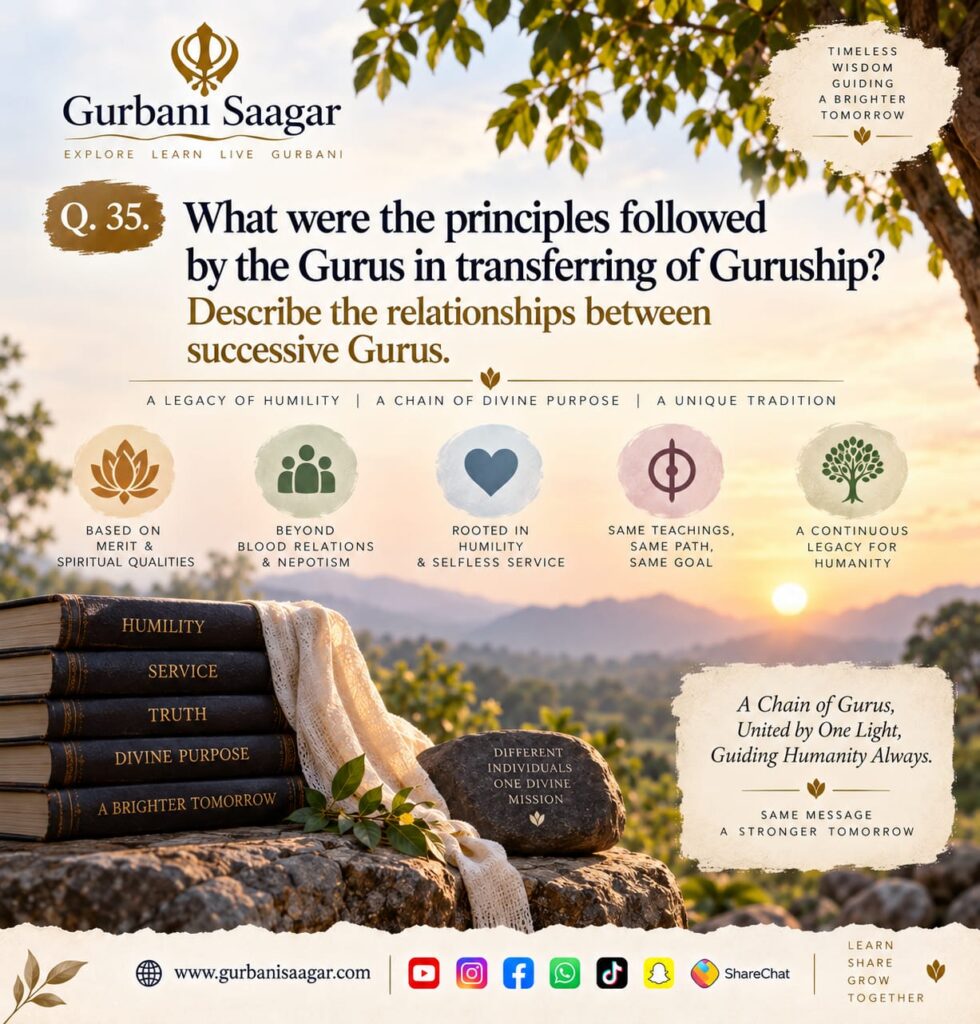
Guruship is not an instrument of luxury or worldly pleasures. It is a great responsibility that could be fulfilled only by those who did not have the slightest ego in their mind. Passing of Guruship by Guru Nanak to Bhai Lehna was a revolution the like of which has never happened in the history of the world.
In 1688 a glorious revolution took place in England when the royal throne changed hands without spilling a drop of blood. But still the crown remained within blood relatives. William and Mary ascended the throne; Mary was the daughter of the previous king, James I.
Bhai Lehna was not even a distant relative of Guru Nanak.
Bhai Gurdas has written that no matter from what angle one looked, the passing of Guruship to Bhai Lehna was a unique and unusual event. It was a novel idea, a glorious revolution and an earth-shaking deed.
First of all, the worldly kings do not give away their kingdoms to anyone while alive; and if at all such an event occurs, it is done only when the king is on the deathbed. But Lehna was installed on the spiritual throne when Guru Nanak himself was still alive.
In the case of worldly kingdoms, as soon as the son would ascend the throne, he would have the army take an oath of allegiance in his name and similarly would have all his subjects declare (under oath) that hereafter they would obey him as their king. All money in circulation (with his father’s name on), would be replaced gradually by that bearing his name. He would establish his control on the treasury and use his seal and proclaim himself the master of all fortune.
But the house of Nanak started a different tradition, a wonderful play. Here neither the path changed nor the goal; neither the rites nor the tradition changed. The one Supreme Being’s Name was lauded. The same mint of holy congregation, the same recitation of Bani (utterances of Guru) from the Pothi, the same one name – that of Nanak in all the sacred hymns, the same one spiritual throne of Guruship and the same seal of Truth and true Name which is accepted in God’s court.
The other (false) empires are fraught with innumerable problems, internecine fights, thousands of anxieties and millions of enmities. But whosoever came under the refuge of this (spiritual) empire, beheld the sight of and bowed before the Guru, received bliss and equipoise. The closer one looks the more fascinating it seems.Guru Nanak gave the (selfless) service of responsibility of Guruship to Bhai Lehna even when he had two sons who considered themselves eligible for this responsibility. Guru Angad Dev passed on this responsibility (and service) to Bhai Amar Das even when his sons were there. Guru Amar Das gave the Guruship to his son-in-law, Bhai Jetha, by-passing his sons. Guru Ram Das by-passed his elder sons and gave the Guru’s throne to his youngest son, Baba Arjan Dev. Guru Arjan Dev passed this responsibility on to his (only) son, Baba Har Gobind. Guru Har Gobind gave the Guruship to his grandson, Baba Hari Rae while his sons were there. Guru Hari Rae gave the Guruship to his youngest son, Baba Hari Krishan although his elder son, Ram Rae, was there. Guru Hari Krishan gave the responsibility of Guruship to his granduncle, Baba Tegh Bahadur. This clearly indicates that in Sikhism the rule of blood relation, lineage (eldest son as king), or nepotism was not observed.
The national poet, Maithali Sharan Gupta, in the chapter “Akaal Purakh” of his book, “Bharat Bharati”, has written: “Even though he had his own sons, Guru Nanak presented a model of benevolence/liberal thinking. The heir to his (spiritual) throne was selected, Bhai Lehna, on the basis of his devotion to the Guru and not on the basis of lineage.
The spiritual emperor, Guru Nanak, was sculpting a pure new social order.